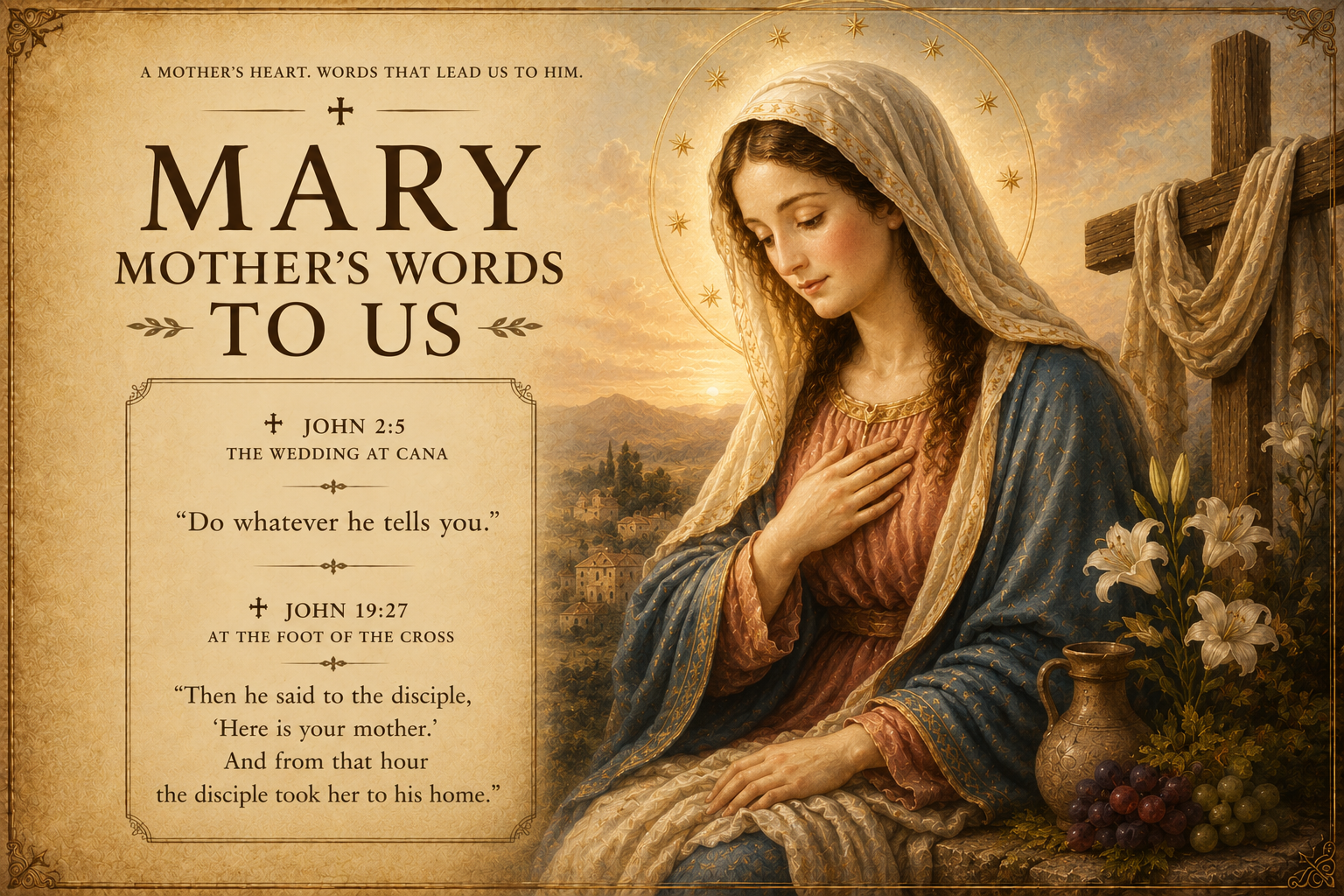
The Assumption of Mary: The Mother Taken Home in Her Body
Mother’s Words to Us · Saturday 15 August 2026
Of all the Marian mysteries the Catholic Church has carried through the centuries, the one celebrated on 15 August is the deepest and the gentlest, that the Blessed Virgin Mary, at the end of her earthly life, was taken up, body and soul, into heavenly glory, by the Lord Jesus Christ her Son. This Marian conviction, held quietly by the Catholic Church for two thousand years, is called the Assumption. The feast is older than the dogma. The Catholic faithful of the Christian East have celebrated the Dormition of Mary since the fifth century. The Catholic faithful of the Latin West have celebrated the Assumption of Mary since the seventh century. On 1 November 1950, Pope Pius XII, after consulting the whole Catholic episcopate, defined the ancient belief as a dogma of the Catholic faith.
The hour
The hour of Mary’s departure from this earthly life is not recorded in the New Testament. The Catholic Church, through her ancient Tradition, holds that the Blessed Virgin Mary lived some years after the Ascension of her Son, probably in Jerusalem and later, under the care of Saint John the Apostle, in Ephesus on the western coast of Asia Minor. The traditional place of her Dormition in Jerusalem, on Mount Sion, has been venerated since the fourth century. The small house in Ephesus where she is said to have ended her earthly life was identified in the nineteenth century through the visions of Blessed Anne Catherine Emmerich.
The ancient Catholic Tradition, preserved in both East and West since the second century, is that Mary did not experience the corruption of the grave. The Christian East speaks of her Dormition, her falling asleep in the Lord. The Christian West speaks of her Assumption, her being taken up. Both traditions, East and West, hold the same Marian conviction: the body that had carried the Lord Jesus Christ, nursed him, buried him, and lived to see him risen from the dead, was not left in the earth. It was taken, body and soul, into the glory of her Son.
On 1 November 1950, in the solemn Papal bull Munificentissimus Deus, in the great Marian year that followed the Second World War, Pope Pius XII, surrounded by hundreds of bishops in Saint Peter’s Square, speaking ex cathedra as the successor of Peter, solemnly defined, as a dogma of the Catholic faith, that:
The words
“The Immaculate Mother of God, the ever-Virgin Mary, having completed the course of her earthly life, was assumed, body and soul, into heavenly glory.”
Pope Pius XII, Munificentissimus Deus, 1 November 1950
What it means
The Catholic Church means that the Blessed Virgin Mary is, right now, body and soul, in the glory of her Son. She is not a disembodied spirit. She is not merely a memory. She is a real human person, with a real human body transformed by the Resurrection of her Son, who sees, hears, and loves every Catholic who turns to her in prayer. The whole Catholic tradition of Marian intercession, which the Catholic Church has carried for two thousand years, rests on this one fact: that the Mother is personally alive, personally present, personally reachable.
And the Catholic Church means that Mary’s Assumption is the first fruit of the Resurrection of her Son. The Lord Jesus Christ rose from the dead on Easter morning as the first-born of the new creation. His Mother, by a special privilege attached to her unique vocation as the Mother of God, has been assumed into that same new creation as the second human person to receive, in her body, the Resurrection glory. Every Catholic who dies in a state of grace will, at the end, follow her. The Assumption is a Marian preview of what the Catholic Church calls the resurrection of the body.
And the Catholic Church means something gentle. The Mother who was taken up, body and soul, into glory, is still a Mother. She did not stop being a Mother when she was glorified. She did not stop looking down with tenderness on her other children, the baptised members of the Catholic Church, when she went home to her Son. The Assumption, Pius XII said in the bull, is the Marian guarantee that the Mother in heaven is still, in every real sense, exactly the Mother the Catholic Church has known on earth.
The witness
Saint John Damascene (whom we met in October), in his Three Homilies on the Dormition (around 740), gave the Christian East its classic theological articulation of the Dormition: “It was fitting that she who had carried in her womb the Creator should dwell in his heavenly tabernacle. It was fitting that she who had held her Son in her lap on earth should be held by his arm in heaven.”
The ancient Catholic liturgical calendars of both the Christian East and the Christian West celebrated the feast on 15 August from the sixth century, under the Eastern name Koimesis (Dormition) and the Western name Dormitio and later Assumptio. The feast is older than the Byzantine schism. The feast is older than the Protestant Reformation. The feast is as old as the Catholic Church of the first millennium.
The Catholic Church, before defining the dogma in 1950, consulted the whole episcopate of the world through the encyclical Deiparae Virginis Mariae (1946). Out of more than 1,181 bishops, more than 98 per cent asked for the dogmatic definition. It was the clearest demonstration of the sensus fidelium, the sense of the faithful, in the entire twentieth century.
Voices that came after
Saint John Paul II, in his encyclical Redemptoris Mater (1987), called the Assumption “the Marian pledge of the resurrection of the body for every baptised Catholic, written into the heavenly state of the Mother.”
Pope Benedict XVI, in his homily on the Assumption of 15 August 2010, said, “The Assumption is not an escape from the human condition. It is the glorification of the human condition. Mary is the first full human being, body and soul, in the full glory of the Risen Christ. Every Catholic is called to follow her.”
Pope Francis, in his Angelus of 15 August 2015, said, “The Assumption is the Mother of God’s Easter. The whole Catholic Church, on this feast, is given a glimpse of what is coming for all of us.”
Why it still matters today
You live in a century that quietly disbelieves in the resurrection of the body. Most Catholic funerals are now celebrated as spiritual farewells, with little visible Catholic conviction that the body in the coffin will, in some real sense, be raised and transformed at the Last Day. The Catholic doctrine of a bodily resurrection, which was the very foundation of the Catholic life of the first three centuries, has, in many Catholic pews, quietly faded.
The Assumption of the Blessed Virgin Mary, this very Saturday morning, is the Catholic Church’s great visible reassurance that the Catholic doctrine of a bodily resurrection is still true. The Mother has already been raised. The Mother is already in heaven, body and soul. The Catholic who grieves at a funeral is grieving as a Catholic who has, in the Marian Assumption, an actual preview of what is waiting.
Our Lady, taken up into the glory of her Son on this feast, walks across two thousand years this Saturday morning, from her glorified place beside the Lord Jesus Christ, into your kitchen, and says, with the certainty of a Mother who is herself the first fruit of the Resurrection:
🌷 “My child, I have gone before you. I am waiting for you. The resurrection of the body is real. I am its first full witness.” 🌷
Pray one slow decade of the Rosary today, this feast of the Assumption, meditating on the Fourth Glorious Mystery, the Assumption of Our Lady into Heaven. Then look at a photograph of someone you love who has gone to the Lord. Our Lady of the Assumption promises you, with the certainty of a Mother who is herself in her body in heavenly glory, that the same transformation she has already undergone is waiting for every Catholic who follows her.
A line to carry into the week
“The Immaculate Mother of God, having completed the course of her earthly life, was assumed, body and soul, into heavenly glory.” 🌹
Pope Pius XII, Munificentissimus Deus, 1950
🌷 Mary, taken up into heaven in your body and soul, first fruit of the Resurrection, pray for us.
Feast day: 15 August (Solemnity of the Assumption, Roman Catholic Church, Holy Day of Obligation)