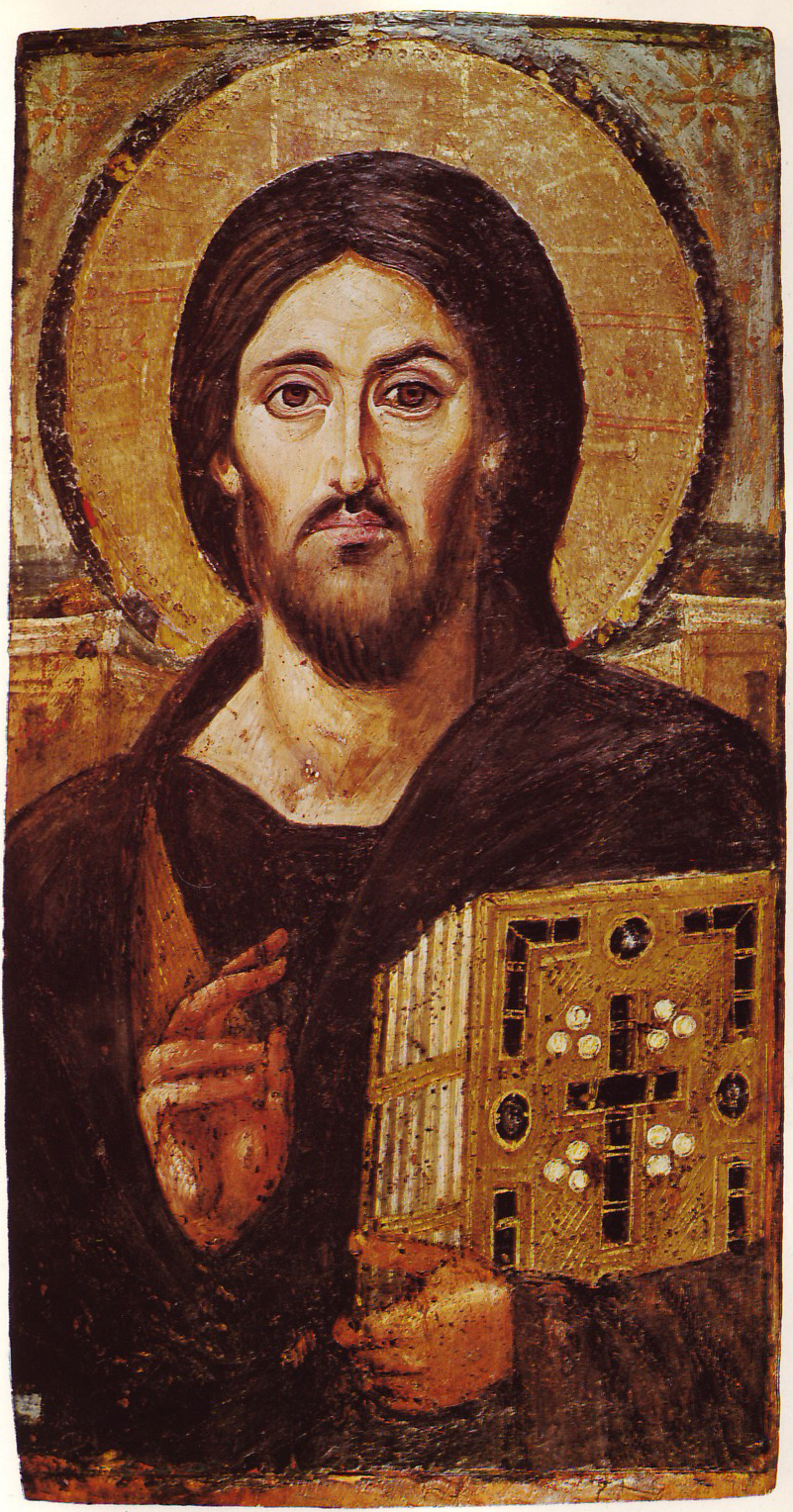
“Lord Jesus Christ, Son of God, have mercy on me, a sinner.”
Among all the prayers of the Christian tradition, one stands out for its simplicity, its great age, and its astonishing power. It is twelve words long. It is prayed by Eastern Catholics and Orthodox monks of Mount Athos, by Roman Catholic laypeople in Western suburbs, by Anglican religious in Wales, and by countless ordinary Christians who have learned it from the pages of The Way of a Pilgrim or from a friend at a retreat. It is called simply the Jesus Prayer.
The prayer itself
Lord Jesus Christ, Son of God, have mercy on me, a sinner.
— the Jesus Prayer
Each phrase carries a weight of Scripture. “Lord” — the title given to the risen Christ throughout the New Testament. “Jesus” — his given name, meaning “God saves” (the angel told Joseph: “You shall call his name Jesus, for he will save his people from their sins,” Matthew 1:21). “Christ” — the Anointed One, the Messiah, the Hebrew Máshíach. “Son of God” — the great confession of Peter at Caesarea Philippi (Matthew 16:16). “Have mercy on me, a sinner” — the cry of the tax collector in Jesus’ parable, who went home justified rather than the proud Pharisee (Luke 18:13).
The prayer is, in essence, the entire Gospel pulled into a single breath. It is a confession of who Christ is, and a humble cry for what we need.
The biblical roots
The Jesus Prayer in this exact form is the fruit of a long tradition. Its earliest roots are in the New Testament itself.
The cry of the blind beggar Bartimaeus on the road to Jericho: “Jesus, Son of David, have mercy on me!” (Mark 10:47). When the crowd tried to silence him, he cried out all the more. Jesus stopped, called him forward, and gave him sight.
The prayer of the tax collector in the temple, who would not even lift his eyes to heaven: “God, be merciful to me, a sinner!” (Luke 18:13). Jesus said this man went home justified.
The Canaanite mother at the borders of Tyre, pleading for her demon-possessed daughter: “Lord, Son of David, have mercy on me!” (Matthew 15:22).
The cry of the ten lepers at the village gate: “Jesus, Master, have mercy on us!” (Luke 17:13).
The Christian East gathered these cries together, joined them to the Holy Name of Jesus, and made of them a single continuous prayer.
The Desert Fathers
In the fourth and fifth centuries, men and women fled the comforts of the Roman world and went into the deserts of Egypt, Palestine, and Syria to seek God in solitude. They were the first Christian monks. Saint Anthony the Great, Saint Pachomius, Saint Macarius, Saint John Cassian — these are the fathers and mothers of Christian monasticism.
From them we have a tradition of short, repeated prayers as a way of fulfilling Saint Paul’s command to “pray without ceasing” (1 Thessalonians 5:17). Saint John Cassian, in his Conferences (c. 420), records the advice given by Abba Isaac on a verse from Psalm 70 that the desert monks would repeat all day: “O God, come to my assistance; O Lord, make haste to help me.” The principle was the same: a single short verse, repeated until it dwelt in the heart.
Saint John Climacus, abbot of Saint Catherine’s Monastery on Mount Sinai in the seventh century, wrote of the practice in his great work The Ladder of Divine Ascent. He counseled: “Let the remembrance of Jesus be united to your breath. Then you will know the value of stillness.”
Hesychasm and Mount Athos
By the fourteenth century, the prayer in its present form was at the heart of the spiritual movement known as hesychasm — from the Greek hesychia, meaning “stillness” or “silence.” The hesychasts were the contemplative monks of Mount Athos, the rocky promontory in northern Greece that has been the heart of Eastern Christian monasticism since the tenth century. Twenty monasteries, over two thousand monks, no women allowed in the territory, the daily round of prayer unbroken since the founding.
The hesychasts taught that the Jesus Prayer, prayed faithfully and joined to the rhythm of the breath, could lead the soul into the experience of the uncreated Light of God — the same divine Light that the disciples beheld at the Transfiguration of Jesus on Mount Tabor.
In the 1330s and 1340s, this teaching was challenged by a Greek philosopher named Barlaam of Calabria, who said that the experience of the Light could not be a true experience of God. The hesychast tradition was defended theologically by Saint Gregory Palamas, archbishop of Thessalonica, in his Triads in Defense of the Holy Hesychasts. Palamas distinguished between the unknowable essence of God and the divine energies by which God communicates Himself. The hesychast experience of the Light, he argued, is a real participation in the divine energies. The Orthodox Church confirmed Palamas’s teaching at three councils of Constantinople (1341, 1347, 1351). It is, to this day, one of the great theological treasures of the Christian East.
When the mind has cleansed itself from the passions and is fixed on the Lord through the Jesus Prayer, the heart is gathered into itself and finds the Kingdom of God within.
— from the hesychast tradition
The Way of a Pilgrim
In the Russian tradition, the Jesus Prayer became widely known to Western Christians through a small nineteenth-century book: The Way of a Pilgrim (Russian: Откровенные рассказы странника). The author is anonymous — an obscure Russian peasant who, sometime around 1853, set out across the great steppes and forests of imperial Russia with a knapsack of dried bread, a Bible, and an old book called the Philokalia, and who tried to obey Saint Paul’s command: “Pray without ceasing.”
A monk taught the pilgrim the Jesus Prayer. He prayed it three thousand times a day, then six thousand, then twelve thousand. Then it began to pray itself in him. The book describes, in plain peasant language, how the prayer descended from his lips, to his mind, to his heart — until it had become as natural as his breathing.
The book was first published in Kazan in 1881. It was translated into French and English in the early twentieth century, and read by Catholic and Protestant Christians as well as Orthodox. J. D. Salinger’s novel Franny and Zooey made the Jesus Prayer briefly famous in mid-century America. Today, The Way of a Pilgrim remains one of the most widely-read spiritual classics in any Christian tradition.
How it is prayed
The Jesus Prayer can be prayed in many ways. Some pray it once, slowly, with attention to every word. Some pray it on a knotted prayer rope (chotki in Russian, komboskini in Greek), saying one prayer per knot, like a Catholic praying a Rosary. The traditional Eastern prayer rope has 33, 50, 100, or 300 knots, made of black wool tied in elaborate seven-cross knots by the monks themselves.
A traditional way of praying it with the breath is this: as you breathe in, pray “Lord Jesus Christ, Son of God”; as you breathe out, pray “have mercy on me, a sinner.” Some practitioners shorten the prayer further, especially in moments of distress: “Lord Jesus, mercy.” Or simply: “Jesus.”
The Christian East teaches that the prayer eventually descends from the lips, to the mind, to the heart. The “prayer of the heart” is the goal of the practice: a simple, continuous awareness of Jesus, settled in the deepest place of the person, like a flame at the center of the soul. This is not achieved by force; it is given as a gift, often after long faithfulness. The hesychast tradition counsels patience and the guidance of a spiritual father.
The Philokalia
The greatest written treasury of the Jesus Prayer tradition is the Philokalia — literally “love of the beautiful” — a five-volume collection of writings by thirty-six Christian authors of the fourth through fifteenth centuries, gathered in 1782 by Saints Nicodemus of the Holy Mountain and Macarius of Corinth. It includes works by Saint John Cassian, Saint Maximus the Confessor, Saint Symeon the New Theologian, Saint Gregory Palamas, and many others. The full English translation, completed in five volumes between 1979 and 2023, is one of the great labors of modern Christian scholarship.
East and West
The Jesus Prayer is most associated with the Christian East — the Greek, Russian, Romanian, Serbian, Ukrainian, Bulgarian, Georgian, Antiochian, and other Orthodox traditions, as well as the Eastern Catholic Churches in full communion with Rome (Maronite, Melkite, Ukrainian Catholic, Coptic Catholic, Syro-Malabar, and others). But it is fully part of the Catholic spiritual heritage and prayed by countless Roman Catholics today.
Pope Saint John Paul II, with his profound respect for Eastern Christianity, often spoke of his love for the Jesus Prayer. In his apostolic letter Orientale Lumen (1995), he called the spiritual treasures of the East — including the Jesus Prayer — one of the lungs of the universal Church. “The Church must breathe with both lungs,” he wrote, echoing the great Russian thinker Vyacheslav Ivanov.
In the Catholic spiritual tradition of the West, similar simple repeated prayers have always existed: “My Jesus, mercy” (the prayer Saint Faustina recorded from Jesus); the Aspirations of Saint Francis de Sales; the litanies of the Holy Name. The Jesus Prayer fits naturally beside the Rosary, beside the Litany of the Sacred Heart, beside any short repeated prayer the faithful have ever loved.
Mary and the Jesus Prayer
On a Marian website it is worth noting: every Hail Mary ends with the name of Jesus. “Blessed is the fruit of thy womb, Jesus.” Saint Bernard of Clairvaux wrote that there is no sweeter sound to a Christian ear than the Holy Name of Jesus. Mary always brings us back to him. Whether you pray the Rosary or the Jesus Prayer, you are in her company — she is the first one who pronounced his name, the morning of his birth, in a stable in Bethlehem.
There is, in fact, a Marian variation of the Jesus Prayer used in some Eastern monastic traditions: “Most Holy Theotokos, save us.” Or, joining both: “Lord Jesus Christ, Son of God, through the prayers of the Theotokos, have mercy on me, a sinner.”
How to begin
You do not have to be a monk, a contemplative, or a scholar to pray the Jesus Prayer. You can begin tonight, walking home, riding the bus, washing dishes.
- Choose a moment. Walking. Driving. The first ten minutes after waking. The last ten before sleep. Don’t try to do it all the time at first.
- Pray the prayer once, slowly. “Lord Jesus Christ, Son of God, have mercy on me, a sinner.” Mean each word.
- Pray it again. Notice when your mind wanders. Bring it back gently.
- Try the breath. Inhale: Lord Jesus Christ, Son of God. Exhale: have mercy on me, a sinner.
- Get a prayer rope if it helps you keep count. Many Eastern Catholic and Orthodox parishes sell them; many monasteries make them as a small income.
- Read The Way of a Pilgrim (about 200 pages, very simple, available in many translations).
- Find a spiritual father or mother if you want to go deeper. The hesychast tradition is firm that the prayer of the heart should not be sought without guidance.
A small reflection
Once. Slowly. Then again, when you remember. Over months, over years, the prayer becomes a small flame at the center of your day. He answers it. He has been waiting for you to ask. The Christian East has a saying: “The Jesus Prayer is the shortest summary of the Gospel; he who prays it is in the company of all the saints.”
Mary said yes. The shepherds heard the angels. The Magi followed the star. The disciples left their nets. And every Christian, in every age, prays the same simple prayer: Lord Jesus Christ, Son of God, have mercy on me, a sinner.