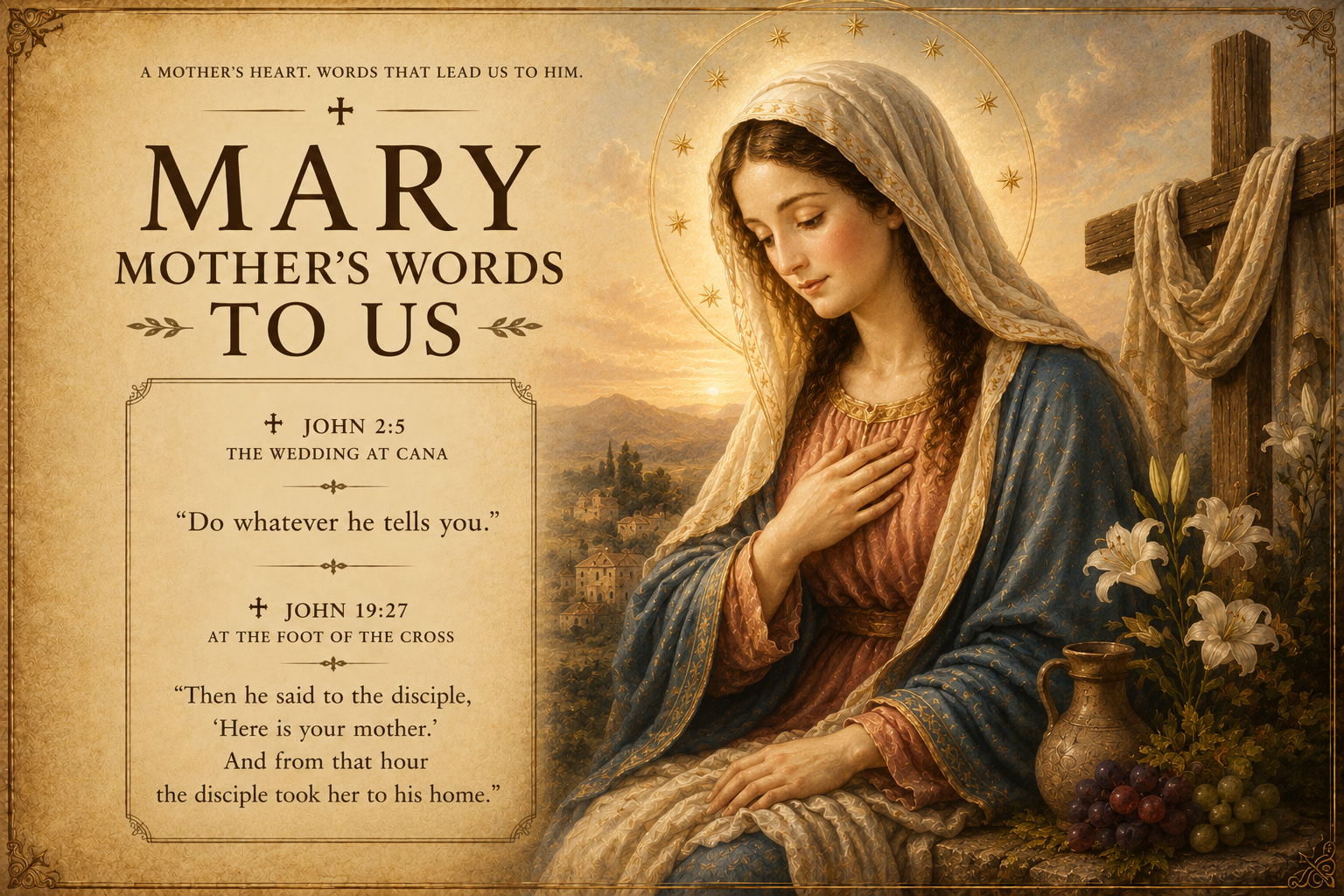
On the day the Church keeps the Memorial of the Immaculate Heart of Mary, the day after the great Solemnity of the Most Sacred Heart of Jesus, we lift our eyes to the place where her Heart and his Heart were one. To Calvary. There, beneath the Cross, Mary stood silent. But in her silence, Jesus gave her one last gift, a son. And he gave us, in her, a Mother forever.
The hour
By the time the centurion’s lance was about to be drawn, almost everyone had left Jesus. The crowds had dispersed. Most of the apostles had fled. The leaders of the people had returned to their council. But four women stayed at the foot of the Cross, with one man.
The Gospel of John, in chapter 19, names them precisely:
“Now there stood by the cross of Jesus, his mother, and his mother’s sister, Mary of Cleophas, and Mary Magdalen.”
John 19:25, Douay-Rheims
And one disciple, the one we know as Saint John, the Beloved.
It was to Mary and to John that Jesus spoke his last recorded words to anyone on earth.
The words
“When Jesus therefore had seen his mother and the disciple standing whom he loved, he saith to his mother: Woman, behold thy son. After that, he saith to the disciple: Behold thy mother. And from that hour, the disciple took her to his own.”
John 19:26-27, Douay-Rheims
That is the whole exchange. Three sentences. No reply from Mary is recorded. None from John. Only obedience, “and from that hour, the disciple took her to his own.”
What Jesus meant
The Fathers of the Church saw at once that the Lord was not merely arranging earthly care for his mother, though he was that too. As her only Son, custom and the Fourth Commandment required it of him. He was doing something else as well.
He was making her the Mother of every disciple. John in that hour stood for us all. “Behold thy mother.” The “thy” includes you, reading this in your kitchen today. “Behold thy son.” The “thy” Mary heard included you, your husband, your children, the priest in your parish, the stranger you have not yet forgiven.
This is the deep Catholic teaching that Mary is Mother of the Church. Pope Saint Paul VI declared it formally at the close of the third session of the Second Vatican Council, on 21 November 1964:
“For the glory of the Blessed Virgin and our own consolation, we proclaim Mary most holy Mother of the Church, that is, of the whole people of God, both faithful and pastors, who call her most loving Mother.”
Pope Saint Paul VI, Discourse closing the third session of Vatican II, 21 November 1964
Pope Francis afterwards, by a decree of the Congregation for Divine Worship dated 3 March 2018, inscribed the new Memorial of the Blessed Virgin Mary, Mother of the Church, on the universal Roman Calendar for the Monday after Pentecost every year. The Memorial exists to honour exactly this moment, when Mary was given by her dying Son to be the Mother of us all.
What it cost her
We do not often say it, but Mary’s “yes” at the Annunciation was completed at the Cross. At Nazareth she said yes to becoming Mother of Jesus. At Calvary she said yes to becoming Mother of every one of us, in him.
The two yeses cost her differently. The first cost her her future. The second cost her her Son.
“And thy own soul a sword shall pierce, that, out of many hearts, thoughts may be revealed.”
Luke 2:35, Douay-Rheims
Simeon’s prophecy, spoken over Jesus when he was forty days old in her arms in the Temple, was now fulfilled. Beneath the Cross, the sword went through her Heart.
And yet, and this is the wonder of the Immaculate Heart, the Gospel does not say she wept aloud. It does not say she fell. It does not say she fled. It says she stood. “There stood by the cross of Jesus, his mother.”
This is the Immaculate Heart at its most pierced and at its most royal moment, the Mother who carried Christ in her womb now carrying him on her Heart, all the way to the end.
Voices that came after
Saint Ambrose of Milan (around 339 to 397) noticed this quiet courage and wrote in his commentary on Saint Luke’s Gospel, “She stood opposite the Cross, looking with motherly eyes on the wounds of her Son, not at all afraid of him who slew, but expecting him who saved.” (Saint Ambrose, Exposition on the Gospel of Luke, Book 10)
Saint Bernard of Clairvaux (1090 to 1153) preached more than ninety sermons on Our Lady and gave the Church the language of “Mediatrix” and “Mother of mercy” that still fills the Catholic liturgy today.
Saint John Eudes (1601 to 1680), the gentle French priest from Normandy, was the first to establish a public liturgical feast of the Heart of Mary (Autun, 8 February 1648) and gave the Church the deep teaching that the Heart of Jesus and the Heart of Mary are so united in love that they are almost one Heart. The two June feasts of the Sacred Heart and the Immaculate Heart belong together because of him.
Saint Louis-Marie Grignion de Montfort (1673 to 1716), in his True Devotion to the Blessed Virgin Mary, gave the Catholic family the great consecration, “to Jesus through Mary.” That is the door Mary opened at the foot of the Cross.
Pope Saint John Paul II, in his encyclical Redemptoris Mater (25 March 1987), wrote that Mary at Calvary entered into “a new motherhood according to the Spirit, and not only that of John, but also that of every disciple.” (Section 23.) That is what Catholic doctrine holds, when Mary heard “Behold thy son,” she became Mother of all of us, then and there.
Why it still matters today
The Immaculate Heart of Mary is not a sentimental devotion. It is a doctrine with a Mother behind it.
When you cannot pray, she prays. When you cannot understand, she ponders for you. When you cannot stand, she stands for you at the foot of the Cross.
“And from that hour, the disciple took her to his own.” That hour is your hour, today. “His own” means his own home, his own family, his own kitchen, his own evening. To take Mary as Mother means to bring her into your house, into your week, into the soft middle of your ordinary Saturday afternoon.
This is what every Catholic family is invited to do today, the Memorial of the Immaculate Heart. Take her in. Place a small statue or icon on the mantelpiece. Speak her name aloud when you cook. Whisper a Hail Mary in the evening with the children. Let her sit at your table.
She has been waiting, two thousand years, to be taken to your own.
A line to carry into the week
“Behold thy mother.”
Pray it tonight in front of the crucifix. Look at Mary in your house, the small statue, the icon, the holy card by the door. Say her name. Then say Saint John’s words, “from that hour, the disciple took her to his own.”
And then take her home.
Immaculate Heart of Mary, pray for us who have recourse to thee.