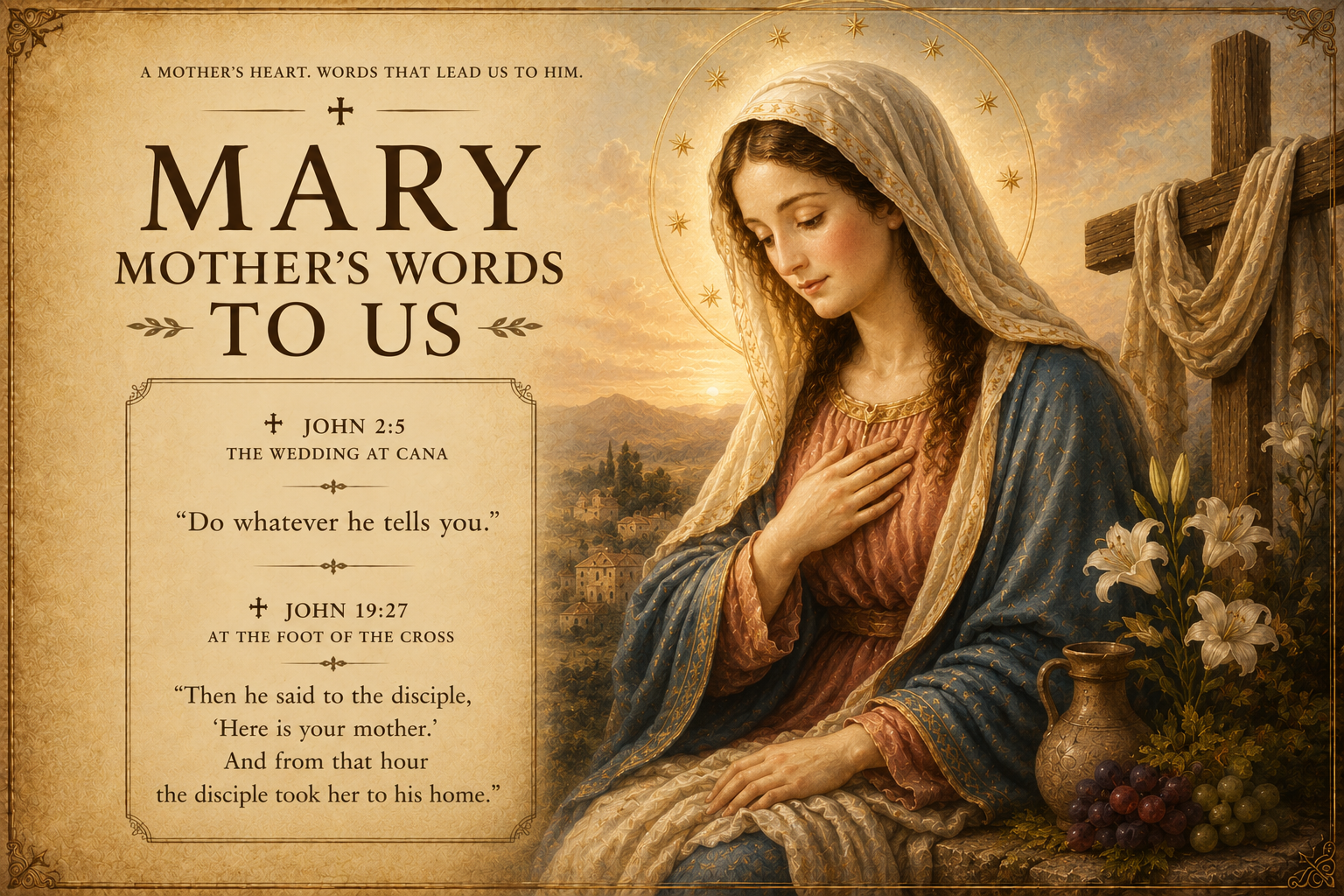
The Holy Name of Mary: The Three Letters That Open Every Door
Mother’s Words to Us · Saturday 12 September 2026
Of all the Marian feasts in the Catholic liturgical year, there is one, kept exactly four days after her birthday, which is dedicated not to any mystery of her life, but simply to her Name. The Catholic Church, having celebrated the Marian Nativity on 8 September, celebrates the Marian Naming on 12 September. The feast is kept in the Christian East under the title The Name of the Theotokos, and in the Catholic West under the title The Most Holy Name of Mary. For the Catholic devotion of all the centuries, the single word “Mary,” said with love, is a prayer in itself, a Marian invocation as powerful as any formal recitation, a Marian word that opens doors no other word opens.
The hour
The Blessed Virgin Mary received her Hebrew name Miryam from her parents Joachim and Anna, following the Jewish custom, on the eighth day after her birth. The Hebrew name Miryam, in Semitic philology, is derived either from the Hebrew root mrr (“bitter,” linking Mary to the suffering of Egypt) or from the Egyptian root mry (“beloved”), or, most beautifully, by the Fathers of the Catholic Church, from the Hebrew phrase mar yam, “star of the sea.”
The Catholic feast of the Holy Name of Mary originated in Cuenca, Spain, in the sixteenth century, as a local Marian devotion. In 1683, after the great Catholic victory at the Battle of Vienna on 12 September 1683, where the Polish King John III Sobieski broke the Ottoman siege of the imperial Catholic capital, Pope Innocent XI, who had carried the whole European Catholic world through the siege with his daily Marian prayers, extended the feast to the universal Catholic Church, fixing it on 12 September in perpetual memory of the Marian victory.
Pope Pius X removed the feast from the general calendar in 1911. Pope John Paul II, in 2002, restored it, as an optional memorial, in the revised General Roman Calendar. The Catholic Church of the Christian East has kept it continuously on various dates. The Catholic Church of Austria, Hungary, and Poland has, since 1683, kept it on 12 September with special solemnity, in perpetual Marian gratitude for the Battle of Vienna.
The words
Of the countless Catholic texts in honour of the Holy Name of Mary, the one line the Catholic Church has carried closest to its heart is the Marian couplet of Saint Bernard of Clairvaux (1090 to 1153), the greatest medieval Marian doctor of the Latin West, in his second homily on the Annunciation:
“When the storms rise, when the waves break, when the night is darkest, look to the star, call upon Mary. If you follow her, you will not stray. If you pray to her, you will not despair. If you cling to her, you will not fall. With her for guide, you will not grow weary; with her for protectress, you will not be afraid. Say her name. Say it again. Mary. Mary.”
Saint Bernard of Clairvaux, Homily II on the Annunciation, around 1140
What it means
The Catholic Church means that the single word “Mary,” said with love, is itself a Marian prayer. The Catholic who is too tired to pray a Rosary, too distracted to pray an Our Father, too anxious to pray anything structured at all, can always, in every moment, say one single word: Mary. That one word, Bernard said, carries into heaven the whole of the Catholic’s intention. The Mother hears it. The Mother answers it. The Mother carries it to her Son.
The Catholic Church means that the Holy Name of Mary is a weapon. The ancient Catholic tradition, carried in the exorcism rituals and the writings of countless Catholic saints, is that the devils of hell flee from the Marian Name. Not because of the sound. Because of the person named. Saint Louis de Montfort, in his Secret of Mary, said, “The devil fears the Name of Mary more than any other, after the Holy Name of Jesus. He flees at its first syllable.”
And the Catholic Church means that the Holy Name of Mary is a Marian door. Every ancient Catholic baptismal name, every Catholic confirmation name, every Catholic religious name, has, for centuries, included Mary in some form, often as a middle name for both men and women. The Catholic who has been given her name has, in effect, been given her maternal access. The Pope John Paul II was baptised Karol Józef Wojtyla and chose, as his episcopal and papal name, the Marian motto Totus Tuus, “I am entirely yours.”
The witness
On 12 September 1683, the Battle of Vienna: a Polish Catholic army under King John III Sobieski, flying the Marian banner of Our Lady of Czestochowa, charged the Ottoman Turkish army of 150,000 that had besieged Catholic Vienna for two months. The Catholic forces won. The siege was broken. The Catholic cry of the Polish winged hussars as they charged down the Kahlenberg hill was simply: “Maria! Maria!”
King John III, after the victory, wrote to Pope Innocent XI in his famous Marian letter: Veni, vidi, Deus vicit. “I came, I saw, God conquered.” The Pope, receiving the news, instituted the Feast of the Holy Name of Mary for the universal Catholic Church, in perpetual memory.
In the Catholic churches of Austria, Hungary, Poland, and the whole Catholic Habsburg world, 12 September has been, since 1683, celebrated with special solemnity, often as a holy day of civic as well as liturgical observance. The great Marian pilgrimages of Mariazell in Austria, of Mariapocs in Hungary, and of Jasna Gora in Poland fall on or near this feast.
Voices that came after
Saint Thomas Aquinas, in his Compendium Theologiae, said, “The three Catholic names that no demon dares to repeat without flight are: Jesus, Mary, Joseph. The second of these, Mary, is the Marian door of mercy that opens on earth every time it is said with love.”
Saint Alphonsus Liguori (1696 to 1787), in The Glories of Mary, dedicated a whole treatise to the Holy Name, calling it “the Marian honey on the lips of the dying Catholic, the Marian armour on the lips of the fighting Catholic, the Marian lullaby on the lips of the suffering Catholic.”
Saint John Paul II, restoring the feast to the universal calendar in 2002, said, “The Holy Name of Mary is one of the most precious Marian treasures of the Catholic Church. It must be given back to Catholic lips, Catholic hearts, Catholic babies, Catholic homes.”
Why it still matters today
You live in a century in which Catholic babies, in many Catholic countries, are no longer named Mary. The ancient Catholic custom of giving the Marian name, as first or middle name, to every Catholic daughter, and sometimes to every Catholic son (think of Rainer Maria Rilke, think of Jean-Marie Vianney), has in many places quietly faded. The small Marian word has been, in a hundred Catholic hospitals, replaced by trendier choices.
Our Lady, bearing the Holy Name her parents gave her in Jerusalem in 18 BC, walks across two thousand years this Saturday morning, with the one soft word in her ear from Saint Bernard, from John Sobieski, from John Paul II, into your kitchen, and says, with the simplicity of a Mother:
🌷 “Call me by my Name. In the night. In the storm. In your fear. Even when you cannot find another word. Just: Mary. I will come.” 🌷
Make a small Catholic commitment this coming week. When something frightens you, when something grieves you, when something overwhelms you, say the one word, slowly, out loud if you can: “Mary.” Our Lady, in the heavenly glory of her Assumption, promises you, with the certainty of the Mother whose Name was spoken by John Sobieski’s cavalry at Vienna, that she hears every single invocation of her Name, and that no Catholic who has ever called on her by Name has been left without her Mother’s reply.
A line to carry into the week
“Look to the star, call upon Mary.” 🌹
Saint Bernard of Clairvaux, Homily II on the Annunciation
🌷 Mary, Holy Name of the Mother, star of the sea, pray for us.
Feast day: 12 September (Most Holy Name of Mary, Roman Catholic Church)