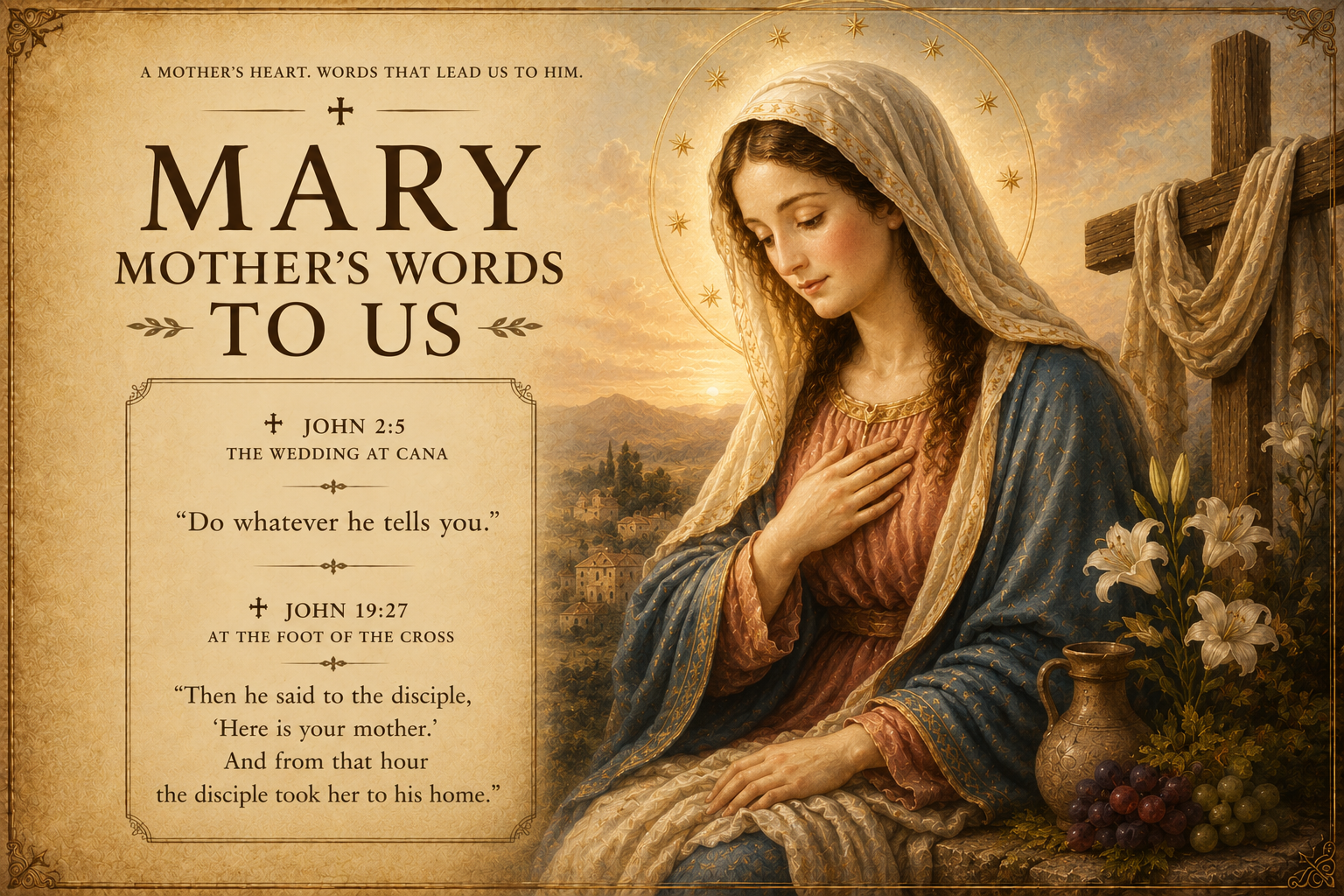
The Nativity of Mary: The Birth of the Dawn Before the Sun
Mother’s Words to Us · Saturday 5 September 2026
Of all the great Marian feasts the Catholic Church celebrates, there are only three that commemorate a birthday. The Lord Jesus Christ on 25 December. Saint John the Baptist on 24 June. And the Blessed Virgin Mary on 8 September. The Catholic Church has celebrated the Marian birthday since the sixth century. The feast is kept across the Christian East and the Christian West on the same day. It is the gentlest Marian feast of the whole liturgical year, a quiet contemplation of the little newborn girl in the arms of her parents Joachim and Anna, the girl in whom God’s whole plan of salvation was about to be prepared.
The hour
The Blessed Virgin Mary was born, by the Catholic tradition that reaches back through the Fathers to the Protoevangelium of James (second century), to Saint Joachim and Saint Anna, a devout elderly Jewish couple of the tribe of Judah and the line of David, in Jerusalem or perhaps in Sepphoris, around 18 BC. The ancient Catholic tradition names them, honours them, and gives Joachim and Anna their own joint feast on 26 July.
Joachim and Anna had been married for many years without children. Both prayed, through long decades of patient Catholic longing, for a child. The ancient Catholic tradition holds that an angel appeared to Joachim in his old age, promising him that his wife Anna would conceive. Anna, in parallel, received the same promise. The daughter who was born of their late, elderly, Jewish Catholic longing was given the Hebrew name Miryam, which in Latin becomes Maria, “the one who is lifted up.”
The feast of her Nativity on 8 September is celebrated by the Catholic Church, East and West, from the sixth century. It is older than the feast of the Immaculate Conception (which falls, by the Marian logic, exactly nine months before, on 8 December). It is older than most of the Marian feasts we celebrate today. It is one of the quiet, ancient, universal Catholic Marian feasts of the first millennium.
The words
Of the many Catholic texts on the Marian birthday, the one the Catholic Church has carried closest to its heart is the Marian antiphon the Benedictines sing at Lauds on 8 September, drawing on the ancient Catholic image of Mary as the dawn before the Sun of her Son:
“Thy nativity, O Virgin Mother of God, has announced joy to the whole world; for from thee has risen the Sun of Justice, Christ our God, who, destroying the curse, has given the blessing; and defeating death, has given us life everlasting.”
Catholic Antiphon of the Nativity of the Blessed Virgin Mary, 8 September
What it means
The Catholic Church means that the Marian birthday is the dawn before the sun. The newborn girl Mary, born into the arms of her devout Jewish parents in a small house in Jerusalem or Sepphoris, is already carrying, in her Immaculate soul, the whole of God’s plan of salvation. The dawn is not yet the sun. The dawn, however, is the sure sign that the sun is coming. The whole Catholic Marian life, the Catholic Marian prayer, the Catholic Marian devotion, is nothing other than the pre-dawn light of the Lord Jesus Christ.
The Catholic Church means that the Marian birthday is a quiet feast. There are no apparitions. There is no spectacular miracle. There is only, in the Catholic imagination of the second-century Protoevangelium, the quiet picture of two elderly Jewish Catholic parents holding their tiny long-awaited daughter in a plain house, in a small village, in the hot Palestinian September of 18 BC. The whole Catholic story of salvation begins, hidden, in that one quiet moment.
And the Catholic Church means that the Marian birthday is a feast of gratitude for every Catholic birth. The Catholic who celebrates 8 September is being quietly asked to remember that every baby, in every Catholic home, is a kind of small Marian promise. The Lord Jesus Christ, who came to redeem the world through a baby girl in Palestine, continues, in every subsequent century, to send into Catholic homes the babies through whom he will quietly build his Catholic Church.
The witness
The feast of the Nativity of Mary on 8 September is one of the oldest in the Catholic liturgical calendar, attested by the sixth-century Hagiopolite calendar of Jerusalem. By the seventh century it was universal in both East and West. In the Eastern Catholic churches, it is one of the twelve Great Feasts of the liturgical year.
In the Catholic Latin West, the feast gave rise, in the fourteenth century, to the shorter form of the Divine Office called the Little Office of the Blessed Virgin Mary, which Catholic laity have prayed in countless households, confraternities, and third orders ever since.
In Catholic iconography, the Nativity of Mary is one of the most charming subjects of Western Christian art. Giotto’s fresco at Padua, Fra Angelico’s panel at Florence, and the great series of Catholic Nativity paintings of the Spanish and Italian seventeenth century all depict the same quiet moment: the elderly Saint Anna in bed, the midwives washing the newborn Mary, Joachim entering with wondering joy, the single candle on the kitchen table, the single olive tree outside the window.
Voices that came after
Saint Andrew of Crete (around 660 to 740), in his First Homily on the Nativity of Mary, said, “Today is the beginning of our salvation. For the Mother of life is born into the world.”
Saint Peter Damian (1007 to 1072), the Benedictine Doctor, said in his sermon on the Nativity of Mary, “God has done nothing greater, in all of creation, than the creation of this one baby. The Catholic Church, celebrating her birthday on 8 September, is celebrating the greatest moment in human history before the Incarnation itself.”
Saint Louis de Montfort (1673 to 1716), in his True Devotion, said, “The Catholic who honours the Marian birthday on 8 September has honoured, with Mary, Joachim and Anna, and through them, the whole Jewish patience of two thousand years that prepared for the Incarnation of her Son.”
Pope Francis, in his homily of 8 September 2015, said, “The Marian birthday is a hidden feast. The Catholic Church celebrates, on this day, the birth of a baby girl in a small village. Nothing visible changed. But everything, in that moment, began.”
Why it still matters today
You live in a century that often finds the ordinary Catholic birth embarrassing. The modern Catholic home celebrates fewer and fewer babies. The Catholic birthrate across the West has fallen below replacement for forty years. The quiet joy of 8 September, the Marian birthday that reminds every Catholic household that one small baby girl in a small Palestinian village changed the whole of human history, is, in many Catholic parishes, celebrated by no one and remembered by few.
Our Lady, newborn in the arms of Saint Anna, walks across two thousand years this Saturday morning, from her mother’s bedside in first-century Jerusalem, into your kitchen on her birthday, and says, with the quiet, undefended joy of a baby in the arms of a Mother who has waited decades for her:
🌷 “My birthday is next Tuesday. Celebrate it. Light a candle. Pray a Hail Mary. Remember my parents, Joachim and Anna. Every Catholic baby since has been a Marian echo of my own quiet beginning.” 🌷
On Tuesday 8 September, the Marian birthday, light a candle in your home. Pray one Hail Mary slowly. Thank the Blessed Virgin Mary for being born. Thank her parents Joachim and Anna for her. Our Lady, newborn in the arms of her mother, promises you, with the certainty of the dawn before the sun, that the small Catholic honour given to her birthday will be remembered, by her, on the day of yours.
A line to carry into the week
“Thy nativity, O Virgin Mother of God, has announced joy to the whole world.” 🌹
Catholic Antiphon, Nativity of the Blessed Virgin Mary
🌷 Mary, newborn daughter of Joachim and Anna, dawn before the Sun of your Son, pray for us.
Feast day: 8 September (Nativity of the Blessed Virgin Mary, Roman Catholic Church)