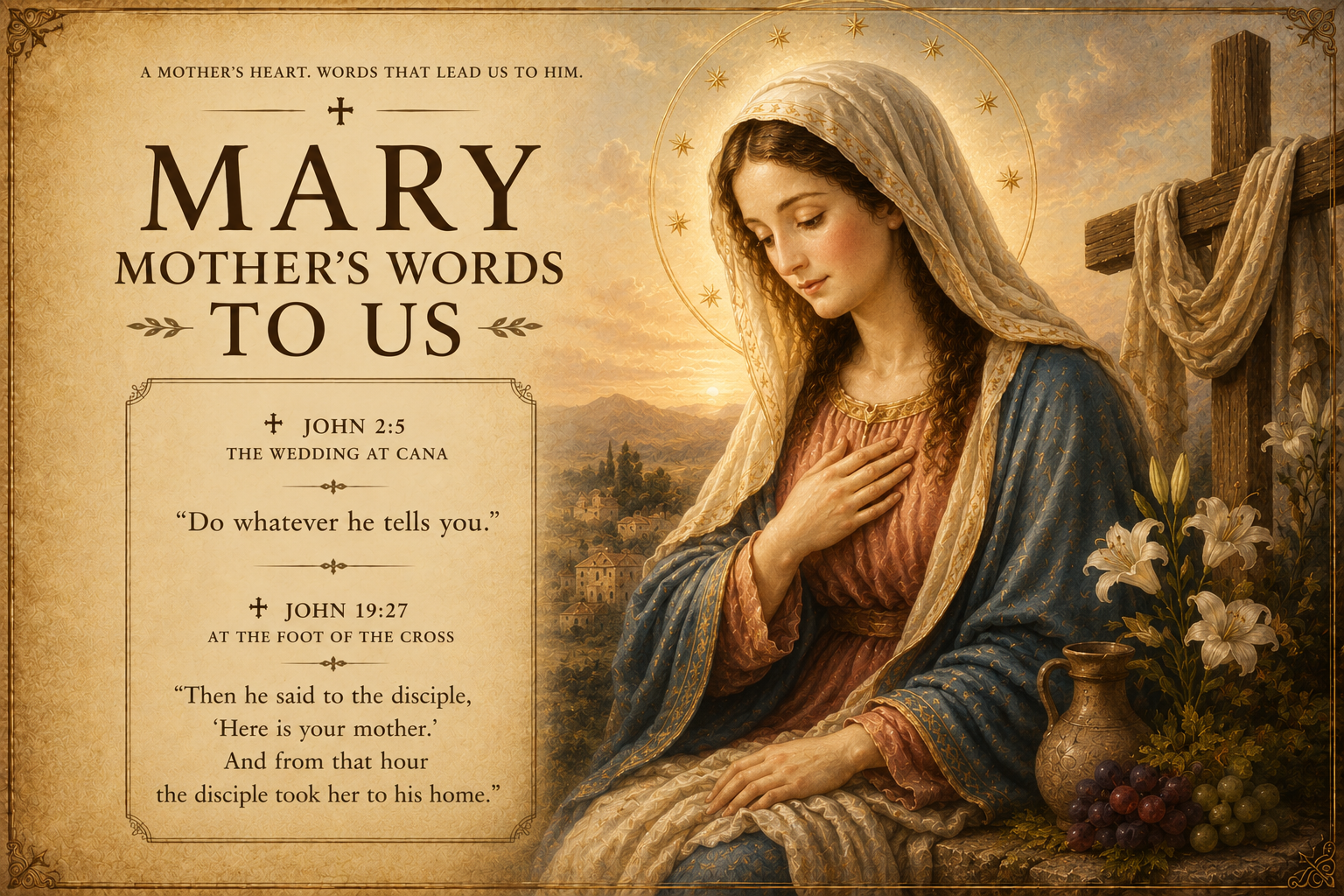
Our Lady of La Salette: The Weeping Mother of the Alps
Mother’s Words to Us · Saturday 18 July 2026
Of all the Marian apparitions the Catholic Church has approved, there is one that happened on the afternoon of 19 September 1846, on a high lonely slope of the French Alps, when the Blessed Virgin Mary appeared, weeping, to two French peasant children, Melanie Calvat, fifteen, and Maximin Giraud, eleven, who were tending their master’s cattle on the mountainside above the small village of La Salette-Fallavaux. She sat on a stone, her face in her hands, sobbing uncontrollably. When she looked up, she gave them the longest spoken message of any approved Marian apparition before Fatima. The Catholic Church remembers her under this title on 19 September.
The hour
France in 1846 was, on the surface, still Catholic. In reality, after the Revolution of 1789 and the long aftermath, the practice of the Catholic faith had collapsed across the French countryside. Sunday Mass attendance had fallen to perhaps ten per cent in many Alpine dioceses. Blasphemy was common. The Sunday Lord’s Day was almost universally ignored. The clergy were old, few, and exhausted. The whole Catholic Church in France seemed to be dying quietly, parish by parish.
On the hot afternoon of Saturday 19 September 1846, the vigil of Our Lady of Sorrows, two illiterate shepherd children, Melanie Calvat, fifteen, and Maximin Giraud, eleven, were tending the cows of their respective masters on the high meadow called the Mountain of La Salette, nearly six thousand feet above sea level in the Isère valley of the French Alps. They had eaten their small lunch of hard bread and cheese by a dry spring, and had fallen asleep for an hour. When they woke, Melanie saw, in the dry hollow of the spring, a globe of fire. Inside the fire sat a Beautiful Lady, her head in her hands, weeping.
The children, terrified, approached. The Lady rose. She was dressed in a long white robe, with a cross on her breast, a hammer and pincers also on the crucifix, and a crown of roses on her veil. Her tears fell as she spoke. She spoke in French. Then, when she gave each child a secret message, she spoke in their own Alpine dialect, so that they understood. She spoke for perhaps fifteen minutes. Then she walked up the slope, rose into the air, and vanished.
The words
The public portion of Our Lady’s message at La Salette, which the Catholic Church approved as authentic in 1851, began with these words:
“Come near, my children, do not be afraid. I am here to tell you great news. If my people will not obey, I am forced to let go the hand of my Son. It has become so heavy, so weighty, that I can no longer uphold it. For how long a time I have suffered for you! If my Son is not to abandon you, I must pray to him unceasingly. And as for you, you take no account of this. Pray well, my children, morning and evening. Many Catholics no longer go to Sunday Mass. The others, when they go, work with the Lord in mockery. They go only to make fun of religion. There are only a very few old women who go to Mass. The rest work on Sunday during the summer. In winter, when they do not know what to do, they go to Mass only to make fun of religion. During Lent they go to the butcher’s shop like dogs. Have you ever seen the wheat go bad, my children?”
Our Lady of La Salette to Melanie Calvat and Maximin Giraud, 19 September 1846
What she meant
Our Lady meant that the Catholic practice of the ordinary Catholic life, Sunday Mass, morning and evening prayer, the keeping of the Sabbath, respect for the holy Name of God, had quietly collapsed in Catholic France, and that her Son was personally hurt by it. She was weeping, she said, because the long arm of divine chastisement, which only her maternal intercession was holding back, was becoming too heavy for her to continue to hold.
Our Lady meant that the Mother is not a sentimental figure in the Catholic life. She is a real intercessor, standing between the Catholic Church and the just judgement of her Son. When the Catholic people neglect prayer, the Mother weeps, and the arm of judgement grows heavier. When the Catholic people return to prayer, the Mother smiles, and the arm is held back.
And Our Lady meant something tender. She called the children, “my children,” twenty-three times in her message. Even in the middle of her weeping, even in the middle of her warning, the Mother spoke, not with anger, but with the exact tone of a mother weeping over a wayward son. She was not threatening the Catholic Church of France. She was begging for her. The whole apparition was a Marian plea for the return of her children to the practice of the Catholic faith.
The witness
The two children came down the mountain that evening and told their masters, who told the parish priest, who at first disbelieved. But a dry spring on the mountain burst into fresh water the next morning, as the Lady had promised, and that spring has flowed continuously ever since. Pilgrims began arriving within weeks.
On 19 September 1851, exactly five years after the apparition, the Bishop of Grenoble, after years of careful investigation, issued a formal decree declaring the apparition “bears within itself all the marks of truth, and the faithful have grounds for believing it indubitable and certain.” It became the first of the great nineteenth-century French Marian apparitions to be formally approved. Pope Pius IX gave his personal approval in 1879.
A great Catholic basilica was built on the mountain, which rises in the shape of a weeping mother over the French Alps, visible from fifty miles away. The Missionaries of Our Lady of La Salette were founded in 1852 and remain, to this day, an active Catholic missionary congregation of priests and brothers.
Voices that came after
Saint John Vianney, the Curé of Ars, who was contemporary with the apparition, said in his old age, “The Mother wept at La Salette. If my fellow priests had wept with her, half the French parishes would still be alive today.”
Our Lady of Fatima, seventy-one years later, in 1917, in Portugal, repeated almost word for word La Salette’s twin themes, Sunday Mass and daily prayer, as the Marian remedies against the chastisements of the twentieth century.
Saint John Paul II, visiting La Salette in September 1996 for the one-hundred-and-fiftieth anniversary of the apparition, said, “The Lady of La Salette is still weeping. She is weeping for Europe. She is weeping for the Mass, forgotten. She is weeping for the Lord’s Day, lost. Her tears have not finished.”
Why it still matters today
You live in a century in which the exact scenes Our Lady described at La Salette, Sunday Mass attendance quietly collapsing in whole countries, morning and evening prayer unknown to younger Catholic generations, blasphemy on the lips of ordinary Catholic young people, the Lord’s Day lost to shopping and sport, are being lived out, not in rural French Alpine villages, but across the whole Catholic West.
Our Lady of La Salette walks across one hundred and eighty years this Saturday morning, down the slope of the French Alps, with the tears still on her cheeks, into your kitchen, and says, in the gentle voice she used with Melanie and Maximin:
🌷 “Come near, my children. Do not be afraid. Pray well, morning and evening. Go to Sunday Mass. The arm of my Son is heavy. Help me to hold it.” 🌷
Make a small Catholic commitment this coming week. Add a morning prayer before you get out of bed. Add an evening prayer before you sleep. Resolve to attend Sunday Mass, if you have slipped, this coming Sunday. Our Lady of La Salette promises you, with the certainty of a Mother who wept on the Mountain of La Salette for the sake of her children, that even one Catholic who returns to prayer helps her, with her small arms, to hold back the chastisement for all the others.
A line to carry into the week
“Pray well, my children, morning and evening.” 🌹
Our Lady of La Salette, 19 September 1846
🌷 Our Lady of La Salette, Reconciler of Sinners, Weeping Mother of the Alps, pray for us.
Feast day: 19 September (Roman Catholic Church)