Our Lady of Mount Carmel: The Mother Who Wraps Us in Her Scapular
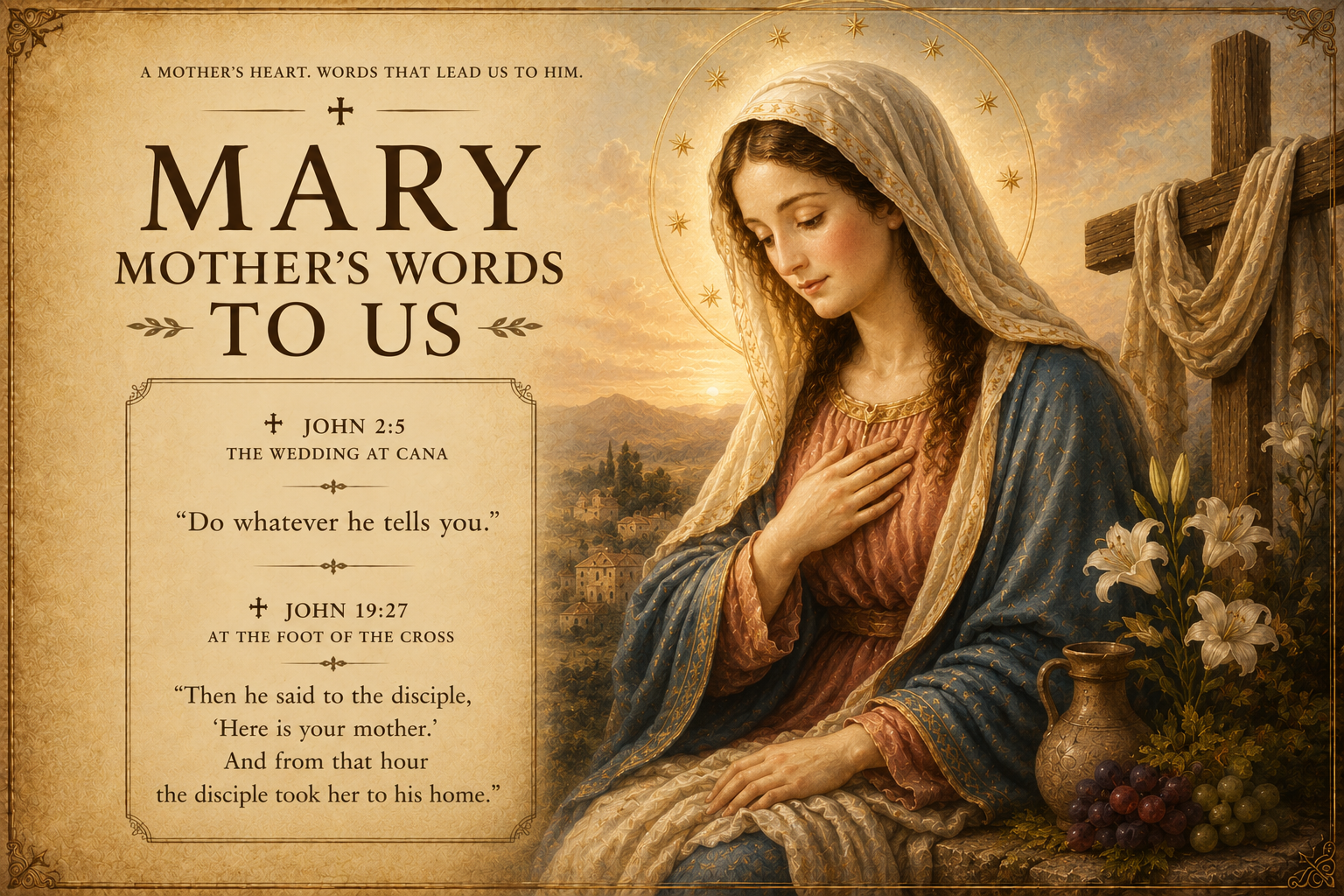
Mother’s Words to Us · Saturday 11 July 2026
Of all the Marian apparitions the Catholic Church has carried through the centuries, there is one that happened in a small chapel on the slopes of Mount Carmel in the Holy Land, in a time of persecution for the Carmelite friars, when, on the morning of 16 July 1251, the Blessed Virgin Mary appeared to the English Carmelite prior Saint Simon Stock. She held in her hand a small brown woollen scapular, placed it over his shoulders, and said to him the single Marian promise that has, for seven hundred and seventy-five years, formed the Catholic devotion of the Scapular. The Catholic Church remembers her, under the title given to that Palestinian mountain where Elijah once prayed, on the Feast of Our Lady of Mount Carmel on 16 July.
The hour
The Carmelite friars had their origin on the actual slopes of Mount Carmel, the great promontory on the Mediterranean coast of the Holy Land where, in the ninth century before Christ, the prophet Elijah had prayed for rain and seen the small cloud rise over the sea (1 Kings 18:44), the cloud that the Catholic tradition has read, for sixteen centuries, as a figure of the Virgin Mary herself.
By the thirteenth century, a group of Latin hermits had settled on Mount Carmel, calling themselves the Brothers of the Blessed Virgin Mary of Mount Carmel. After the fall of the Latin Kingdom of Jerusalem, they fled to Europe, where in the mid-thirteenth century, under heavy opposition from the universities and the diocesan clergy, their very existence as an Order was threatened. The sixth Prior General, an Englishman named Saint Simon Stock (around 1165 to 1265), prayed every day the Marian antiphon Flos Carmeli, “Flower of Carmel,” asking Our Lady to save the Order.
On the morning of 16 July 1251, in the Carmelite priory at Aylesford in Kent, England, Simon Stock, having said Mass and finished his prayers, remained kneeling before the altar. The Blessed Virgin Mary appeared to him, surrounded by angels, holding in her hand a small brown woollen scapular, the long cloth that forms the central part of the Carmelite habit. She placed it over Simon’s shoulders. She looked into his eyes. And she spoke.
The words
“Receive, my beloved son, this scapular of your Order. This shall be to you and to all Carmelites a privilege, that whosoever dies clothed in this shall not suffer eternal fire. Behold the sign of salvation, a safeguard in danger, a covenant of peace and of my own perpetual care.”
The Blessed Virgin Mary to Saint Simon Stock, Aylesford, 16 July 1251
What she meant
Our Lady meant that the small brown scapular, worn under the clothes, over the heart, is her own mantle wrapped around the Catholic soul. The scapular is not a magical charm. It is not a lucky amulet. It is a sign, the Blessed Virgin said, exactly as a wedding ring is a sign. The scapular is the external token of a quiet, interior Catholic consecration to her, in which the Catholic says, “I belong to my Mother.”
The Marian promise, read in the Catholic tradition since the thirteenth century, is that the Catholic who dies in a state of grace, wearing the scapular, is wrapped by Mary herself in the moment of death. She does not save by the cloth. She saves by her Son. But the Catholic who has worn her sign all his life has, in that final moment, placed himself in her hands, and the Mother will carry what she has promised to carry.
And Our Lady meant something deeper. The scapular, she said, is a covenant. A covenant is a reciprocal promise. The Catholic promises to live, from this day forward, as a child of Mary. The Mother promises to carry that child through every danger, through every temptation, through the hour of death, into the arms of the Lord Jesus Christ. The two sides of the covenant are inseparable. The Catholic who wears the scapular has entered a formal, Marian relationship with Our Lady herself.
The witness
Saint Simon Stock lived to see the Carmelite Order saved. Pope Innocent IV approved the Carmelite Rule definitively in 1252, a year after the apparition. The brown scapular became, from that moment, the sign of the Catholic devoted to the Blessed Virgin of Mount Carmel.
From the thirteenth century to the twenty-first, countless Catholics have worn the brown scapular, and the Carmelite tradition has preserved hundreds of accounts of Catholics saved from danger, converted on their deathbeds, carried through sudden death with the scapular found over their hearts. The Catholic Church, cautious as always with such accounts, does not require belief in any of them. But the Church has, from the Middle Ages, warmly endorsed the Marian devotion itself. Popes from Clement VII to John Paul II have personally worn the brown scapular.
In 1251, there was Simon Stock in Kent. In 1917, at Fatima, in the final apparition on 13 October, the Blessed Virgin appeared to the three Portuguese children as Our Lady of Mount Carmel, holding the scapular. Sister Lucia dos Santos, the oldest of the Fatima visionaries and later a Carmelite nun, said in later life, “The scapular is the sign of our consecration to the Immaculate Heart. Our Lady wants everyone to wear it.”
Voices that came after
Saint Teresa of Ávila (1515 to 1582), the great reformer of the Carmelite Order, wore the brown scapular and taught every one of her Discalced Carmelite nuns to see it as the “wedding garment of the Catholic soul.”
Saint Thérèse of Lisieux (1873 to 1897) was clothed in the Carmelite habit at fifteen, received the brown scapular, and wore it every day for the nine remaining years of her short Catholic life.
Saint John Paul II, in a letter to the Carmelites for the seven-hundred-and-fiftieth anniversary of the apparition (2001), said, “I myself have worn the brown scapular over my heart since my boyhood in Poland. The Mother of Mount Carmel has not failed me. She will not fail any Catholic who places himself under her mantle.”
Pope Benedict XVI, in his audience of 16 July 2005, called the brown scapular “the simplest, cheapest, and perhaps most beautiful Marian sacramental the Catholic Church has ever given her children.”
Why it still matters today
You live in a century that has largely forgotten the Catholic scapular. Many Catholics have never been enrolled, never been clothed, never been told that the simple brown cloth is a Marian sacramental the Church has carried for more than seven hundred years. The lives of countless Catholic grandmothers who wore it under their blouses, every day, until the moment of their death, have ended, and the quiet tradition has, in many places, not been passed on.
Our Lady of Mount Carmel walks across seven hundred and seventy-five years this Saturday morning, out of the small priory chapel at Aylesford in Kent, with the brown scapular in her hands, into your kitchen, and says, with the quiet certainty of a Mother who promised Simon Stock perpetual care:
🌷 “My child, let me wrap you. Wear my sign. I will carry you to my Son. I have never failed one who trusted me with the scapular.” 🌷
If you have never been enrolled in the Brown Scapular, ask your parish priest, this coming week, for enrolment. The ceremony is brief, lovely, and free. Receive the small cloth. Place it over your heart. Wear it, under your clothes, from that day forward. Our Lady of Mount Carmel promises you, with the certainty of the Marian covenant she entered with Simon Stock on 16 July 1251, that she will carry you home.
A line to carry into the week
“Behold the sign of salvation, a safeguard in danger, a covenant of peace and of my own perpetual care.” 🌹
Our Lady of Mount Carmel to Saint Simon Stock, 16 July 1251
🌷 Our Lady of Mount Carmel, Mother of the Scapular, Flower of Carmel, pray for us.
Feast day: 16 July (Roman Catholic Church)