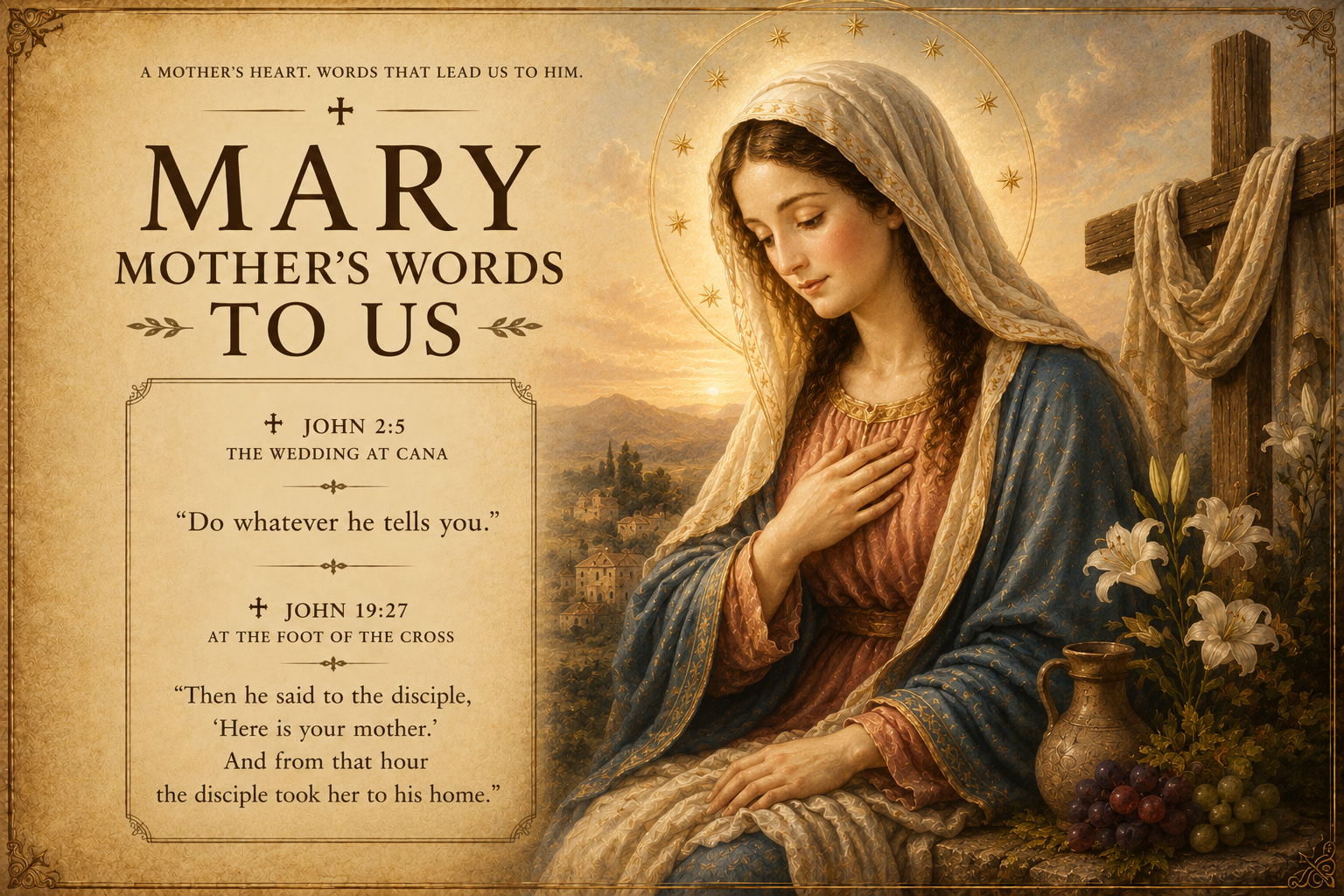
In the Catholic family there is no grief our Mother has not already carried. The widow’s grief. The mother of a wayward son. The mother whose child has died. The mother who watches the world her children must walk into and cannot sleep. To every one of these mothers, the Catholic Church has, for sixteen hundred years, given Mary a quiet, ancient title. The Mother of Consolation. And the first mother she ever consoled was a North African widow who could not stop crying for her son.
The hour
It is the year 387, in the small Roman port town of Ostia, at the mouth of the Tiber, just before the boats sail south for Africa. A North African widow named Monica, in her mid fifties, stands at a small window with her son. She has spent the last seventeen years of her life weeping for him. She has crossed the sea after him. She has knelt in churches for him. She has, by her own admission, prayed “buckets of tears” for him. The son is Augustine, and he is now thirty-three, baptised at last by Saint Ambrose in Milan, and he is going home with her to give his life to God.
Monica dies a few weeks later. “Lay this body anywhere,” she tells Augustine, “the only thing I ask is that you remember me at the altar of the Lord, wherever you may be.” (Saint Augustine, Confessions, Book IX, chapter 11.)
The tradition of the Catholic Church holds that Monica was, in her years of weeping, consoled by Mary herself. The Augustinians have told the story for over a thousand years. Mary, the Mother who had stood beside her own dying Son, appeared to Monica in her widow’s mourning, wearing the same plain dark leather belt of a widow, and gave the belt to Monica with one short sentence.
The words
“I am the Mother of Consolation. Console all who weep.”
Augustinian tradition, Belt of Saint Monica
The leather belt of the widow Mary gave to the widow Monica became the Cincture of Our Lady of Consolation. The Augustinians wear it on their habits to this day. The faithful who join the Confraternity of the Cincture pledge to do exactly what Mary asked, console all who weep.
Mary’s own Scriptural words in the Magnificat are the same teaching in a different voice:
“He hath put down the mighty from their seat, and hath exalted the humble. He hath filled the hungry with good things; and the rich he hath sent empty away.”
Luke 1:52-53, Douay-Rheims
The Mother of Consolation is the Mother who lifts up. She always has been.
What she meant
Mary did not console Monica by promising that everything would be easy. She consoled her by standing next to her in the same widow’s belt. Mary’s consolation is not a smile across a distance. It is a Mother who has walked the same road, in the same clothes, weeping the same tears, telling you that you are not alone.
This is the deepest Catholic teaching on Marian consolation. Mary is not a distant goddess of comfort. She is the woman who lost Joseph (we believe, before the Cross) and lost her Son three days after Passover. She knows. She has buried. She has wept. And she has come through, on the other side, with her Heart still beating for every one of her children.
When she appeared to Monica, she did not give her a theology. She gave her a belt. Something you can wear. Something you can touch. Something on your skin all day long that says, I am here, daughter, I have worn this too.
The icon at Genazzano
The story of Mary as the Mother of Consolation has a second great chapter. On 25 April 1467, in the small Italian hill town of Genazzano south-east of Rome, a poor woman named Petruccia had given the last of her money to begin rebuilding a half-ruined Augustinian church dedicated to Our Lady. The money ran out. The walls stopped, only knee-high. The townspeople laughed at her.
On the feast of Saint Mark, in the middle of a festival, a small cloud descended onto the unfinished wall, and when it lifted, a small fresco of Our Lady and the Child was on the wall. It is paper-thin, no thicker than an eggshell, and to this day it appears to rest on the wall rather than be painted into it. Tradition holds it came from the destroyed church of Scutari in Albania, carried by angels at the very moment the Ottomans took the city.
This image is now known as Our Lady of Good Counsel of Genazzano, and she is one of the great consoling Mothers of the Catholic Church. Pope Leo XIII (1810 to 1903) had a deep personal devotion to her and inserted the title “Mater Boni Consilii,” Mother of Good Counsel, into the Litany of Loreto in 1903. She and Our Lady of Consolation are, in the heart of the Augustinian tradition, the same Mother in two veils.
Voices that came after
Saint Augustine himself, the son for whom Monica wept, became Bishop of Hippo and preached often on the Mother of God. He never forgot his mother’s tears, or the Mother who had stood with her in them.
Saint Rita of Cascia (1381 to 1457), the Augustinian widow and mystic of Umbria, took up the Cincture and was famously called “the Saint of the Impossible,” the one who consoles every Catholic mother who has been told “this cannot be fixed.”
Pope Saint Leo XIII, inserted “Mater Boni Consilii,” Mother of Good Counsel, into the Litany of Loreto by his decree Ex Quo Beatissima of 22 April 1903, taking the title universally into the prayer of the Catholic Church.
Pope Saint John Paul II, who knew grief well, visited Genazzano on 22 April 1993, on the eve of his pastoral trip to Albania, and prayed for many minutes alone before the fresco. A few days later he consecrated Albania to Our Lady of Good Counsel of Genazzano.
Why it still matters today
There is no Catholic family that does not need her this Saturday.
The mother whose son has stopped going to Mass. The mother whose daughter is far away. The widow whose husband is suddenly not at the kitchen table. The mother whose child has died and whose grief no one else seems to remember anymore. The grandmother who whispers her rosary while the rest of the house sleeps.
Mary, Mother of Consolation, has been in the same belt. She knows. She is not somewhere else, looking down. She is sitting right beside you at the kitchen table, wearing her own mourning, and saying very quietly, “I have been here too, daughter. We will come through this together.”
A line to carry into the week
I am the Mother of Consolation. Console all who weep. 🌹
🌷 Our Lady of Consolation, Mother of all who mourn, pray for us.
Feast day (Augustinian Order): 4 September