Of all the great Marian apparitions of the Catholic Church, there is only one in which Our Lady spoke no words. She came, with Saint Joseph at her right and Saint John the Evangelist at her left, in pouring rain, on the back wall of a small Irish parish church, on a Thursday evening in August 1879, and stood there for almost two hours, in absolute silence. Her hands were lifted. Her eyes were lifted to heaven. And she did not say a single word. Our Lady of Knock is the silent Mother. And in the year of the silence of Abba Arsenius, she is the answer the Catholic Church has been holding for one hundred and forty-seven years.
The hour
It is Thursday 21 August 1879, in the small village of Knock, in County Mayo, on the wet west coast of Ireland. The country is once again in a year of failed harvests and growing rural distress, the year the Land War in Ireland began. The harvest has failed. The parish priest has been at a funeral earlier that day. The rain is steady. The wind is from the Atlantic. The little parish church of Saint John the Baptist, plain and grey, stands at the centre of the village.
At about eight o’clock in the evening, the priest’s housekeeper, a woman named Mary McLoughlin, walks past the gable wall on her way to a neighbour’s house. She sees light. She thinks at first that the parish priest has bought new statues and left them outside in the rain by mistake. She walks closer. She stops.
She runs to fetch her friend Mary Beirne. Mary Beirne fetches her own family. Word spreads down the lane. Within an hour there are fifteen witnesses, aged from five to seventy-five, standing in the rain on the wet grass beside the gable wall of the parish church. They will stand there, in the pouring rain, for almost two hours. Not one drop of rain falls on the wall in front of them. The grass beneath the figures stays bone dry.
What they see is this. Three figures stand against the back wall of the church, perhaps eighteen inches above the ground, lit by a soft, steady light.
🌷 In the centre stands the Blessed Virgin Mary, crowned with a beautiful brilliant crown, robed in shining white, her hands lifted in prayer, her eyes lifted up to heaven.
🌷 At her right hand stands Saint Joseph, his head turned in reverence toward her, his beard greying, his robes white.
🌷 At her left hand stands Saint John the Evangelist, the Beloved Disciple, vested as a bishop in white, holding an open book of the Gospels, his right hand raised as though preaching, his eyes resting on the central altar that stands beside them.
🌷 Beside them on a plain altar stands a small white Lamb, alive, looking out at the witnesses. Behind the Lamb is a cross. Angels in worship surround the altar, their wings moving softly.
Not one figure moves. Not one word is spoken. The witnesses recite the Rosary. The vision lasts about two hours. At about ten o’clock it fades.
The words
🌹 There are no words.
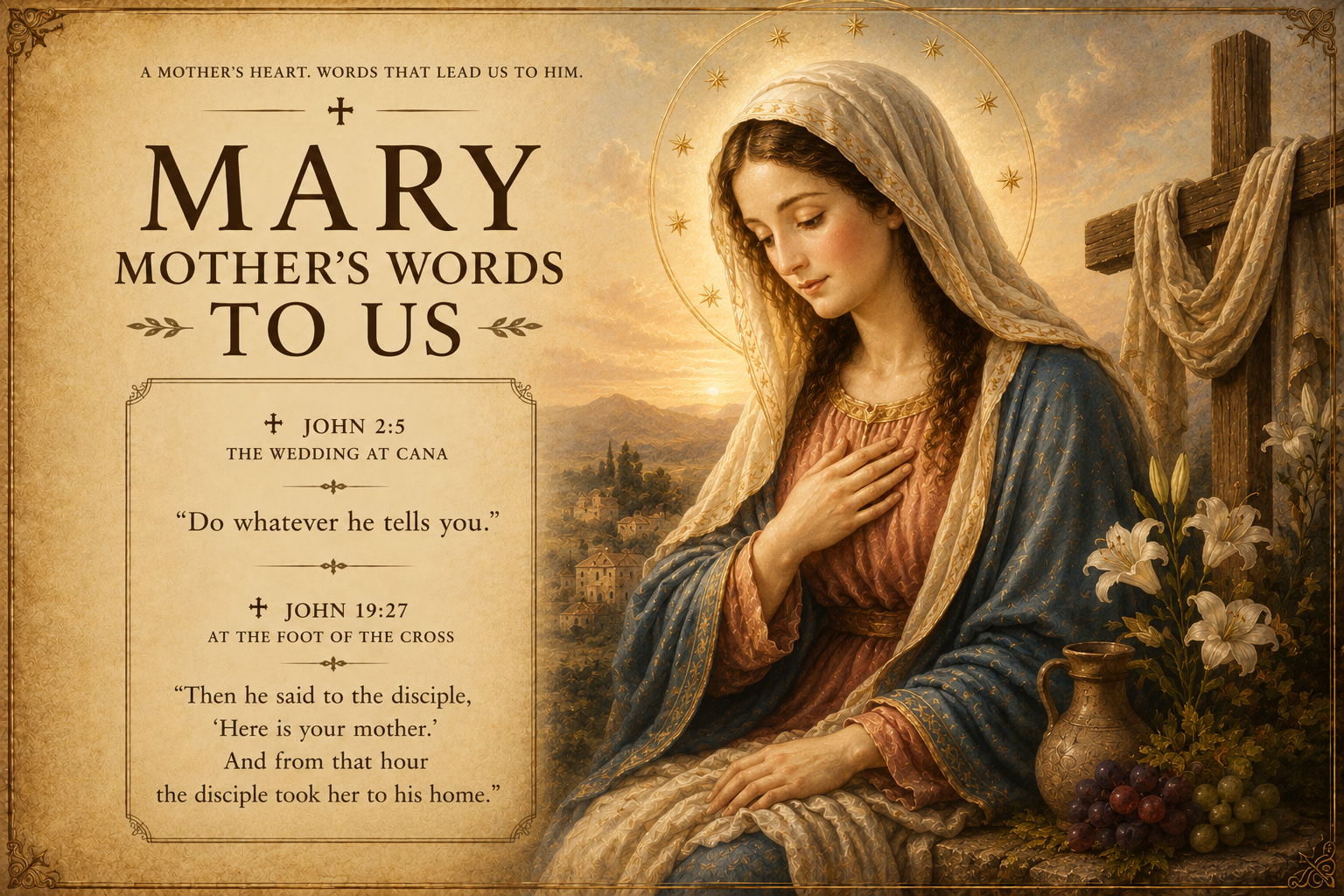
Mary, who at Cana said “do whatever he tells you,” and at Fatima would later speak of the Immaculate Heart, and at Lourdes said her own name in the dialect of Bigorre, at Knock said absolutely nothing. Her silence was her message. The Catholic Church has held this silence as one of its tenderest gifts ever since.
But the Scripture line the Catholic tradition has always set beside her at Knock is this, the verse Saint Luke wrote about her after the shepherds had left the manger and the angels had stopped singing:
“But Mary kept all these words, pondering them in her heart.”
Luke 2:19, Douay-Rheims
Mary at Knock did at her apparition exactly what she did at the manger, she pondered. She lifted her eyes to heaven. She lifted her hands in prayer. And she let the Lamb on the altar speak for her.
What she meant
The Lamb on the altar at Knock is the heart of the apparition. It is the Lamb of God, the Eucharist, the Body of Christ that every Catholic priest in every parish in the world lifts above the altar each morning. Mary at Knock came, with Saint Joseph and with Saint John the Evangelist (the apostle who took her to his home after the Cross, John 19:27), to stand beside the altar of her Son.
She did not need to speak. She gestured the Catholic family back to the Mass. Saint Joseph’s silent reverence was the silent reverence every Catholic father is asked to bring before the tabernacle. Saint John’s open book was the Word of God preached at every Sunday Mass. The Lamb was the Body of Christ. The angels were the angels who stand around every altar at every Mass, even in the smallest parish in Ireland in a grey wet field in 1879.
This is the deepest teaching of Our Lady of Knock. The Catholic life is centred on the Mass. The Mother of God will lead you there in silence and let her Son do the speaking from the altar.
The witnesses
The fifteen witnesses ranged in age from five-year-old John Curry to seventy-four-year-old Bridget Trench. They were poor Irish farmers and farm hands. That October the Archbishop of Tuam, John MacHale, set up a commission of inquiry. The witnesses were interviewed separately, repeatedly, and harshly. Their stories matched in every detail. A second commission in 1936 confirmed the same finding. The Catholic Church regards the Knock apparition as worthy of belief.
Bridget Trench, the seventy-four-year-old, said afterwards that she went up to the gable wall and tried to kiss the feet of Our Lady. “I felt nothing in my arms but the wall, and I wondered why I could not feel with my hands the figures which I had so plainly and so distinctly seen.” That single line is what makes Knock real. A real old woman, in a real wet field, kissing nothing but stone, and convinced she had seen heaven.
Voices that came after
Pope Saint John Paul II visited Knock on 30 September 1979, the centenary of the apparition. He raised the Sanctuary to the rank of a Basilica, presented the shrine with the Golden Rose (the highest papal honour given to a Marian shrine), and said in his homily that day, “Here I am at the goal of my journey to Ireland, the Shrine of Our Lady of Knock. Since I first learned of the centenary of this shrine, which is being celebrated this year, I have felt a strong desire to come here, the desire to make yet another pilgrimage to the place which Our Lady has chosen to honour and from which she dispenses her favours.”
Pope Francis visited Knock on 26 August 2018, during the World Meeting of Families in Ireland, and prayed in silence before the apparition wall for several minutes.
The Catholic Church recognises Knock as an International Eucharistic and Marian Shrine, one of only a handful in the world. Pilgrims have come for one hundred and forty-seven years. The Lamb still stands above the altar where Mary pointed silently in 1879.
Why it still matters today
Our Lady of Knock is the Mother every Catholic family on these islands needs in 2026.
She is the Mother who does not need to explain herself. She does not need to post. She does not need to comment. She does not need to defend her Son in argument. She stands beside the altar, lifts her hands and her eyes, and lets the Lamb speak.
When you are tired of the noise of this century, of the explanations and the corrections and the small, hot arguments on the screen in your pocket, come to Knock in your kitchen. Light a small candle. Place a picture of her on the mantelpiece. Lift your hands. Lift your eyes. Say nothing.
She will not say anything either. She will only point, very quietly, at the tabernacle in your parish church, and say with her eyes, “go to the Lamb.”
A line to carry into the week
“Mary kept all these words, pondering them in her heart.” 🌹
Luke 2:19, Douay-Rheims
🌷 Our Lady of Knock, Mother of the silent altar, pray for us. Saint Joseph, silent guardian of Jesus, pray for us. Saint John the Beloved, who took her to his home, pray for us.
Feast day: 17 August (Ireland)