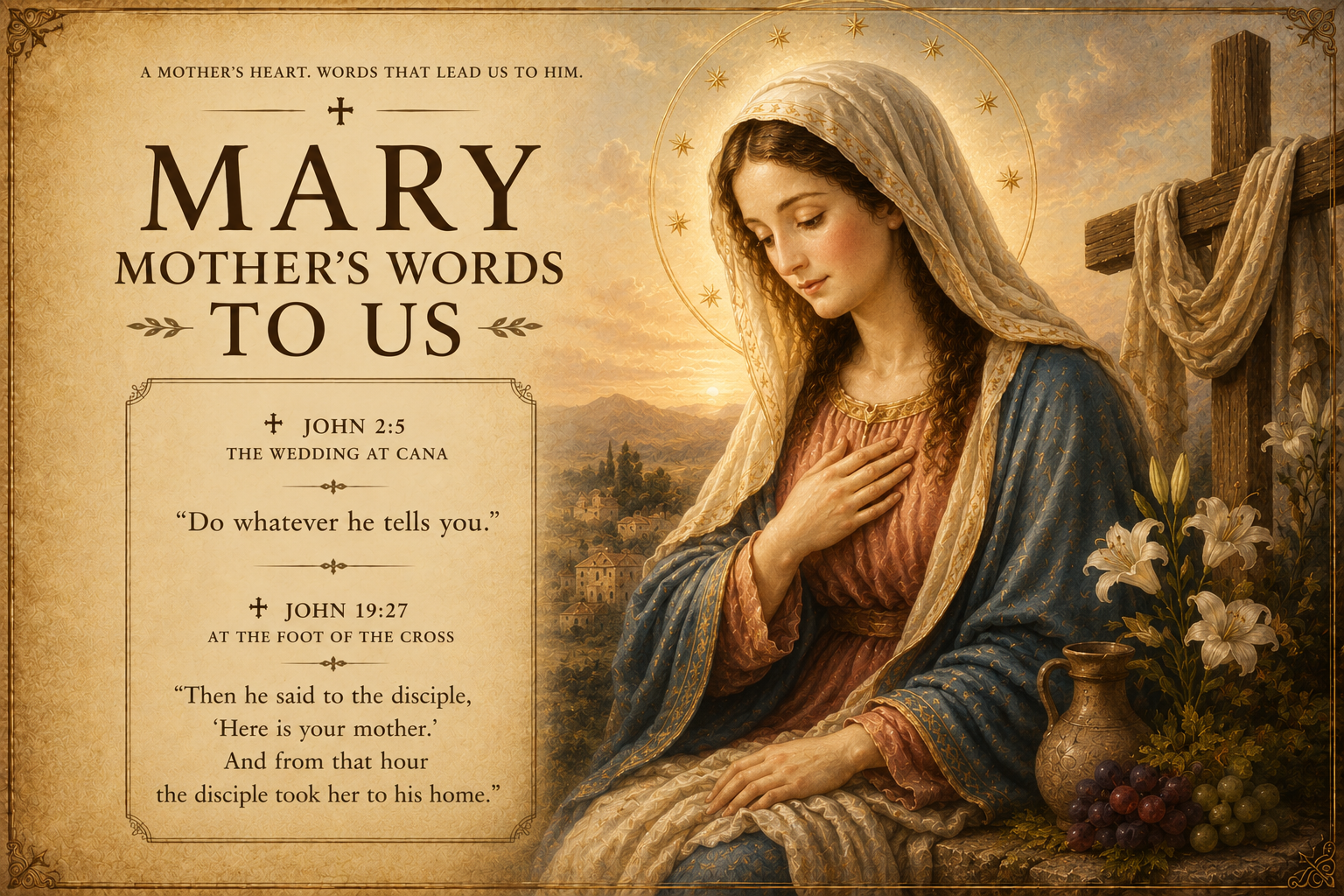
Our Lady of Sorrows: The Mother Pierced by Seven Swords
Mother’s Words to Us · Saturday 19 September 2026
Of all the Marian feasts the Catholic Church celebrates, there is one, kept the day after the Triumph of the Holy Cross on 15 September, that is almost the gentlest and the darkest together. The Catholic Church, having contemplated on 14 September the Cross on which the Lord Jesus Christ died, pauses on 15 September to contemplate the Mother standing at its foot. The Catholic iconographic tradition shows her with seven swords piercing her Immaculate Heart, one for each of the seven sorrows the ancient tradition has counted. She is Our Lady of Sorrows, Mater Dolorosa, Stabat Mater, the Mother who stood.
The hour
The Catholic devotion to the Sorrows of Mary dates to the eleventh century, and received its definitive form in the thirteenth century through the Servite Order (the Order of the Servants of Mary), founded in Florence in 1233 by seven devout Catholic laymen who gave up their businesses to live as hermits dedicated to the Marian compassion. The Servites, from the beginning, focused their Marian devotion on the Seven Sorrows.
The Seven Sorrows of the Blessed Virgin Mary, as the Catholic tradition has counted them since the Middle Ages, are:
1. The prophecy of Simeon, when, holding the forty-day-old infant Jesus in his arms in the Temple, he said to Mary: “A sword shall pierce thy own soul also” (Luke 2:35).
2. The flight into Egypt, when Herod sought the life of her child.
3. The loss of Jesus in the Temple for three days, when the twelve-year-old Lord Jesus Christ remained in Jerusalem.
4. The meeting of Mary and Jesus on the road to Calvary, at the Fourth Station of the Cross.
5. Standing at the foot of the Cross, as her Son died.
6. Receiving the dead body of her Son into her arms, the moment the Catholic iconographic tradition calls the Pietà.
7. Laying her Son in the tomb.
Pope Pius VII, in 1814, after his years of captivity under Napoleon, extended the feast to the universal Catholic Church, fixing it on 15 September, the day after the Triumph of the Holy Cross. The feast is kept with a Sequence, the magnificent thirteenth-century Latin poem Stabat Mater Dolorosa, “The sorrowful Mother stood weeping beside the Cross.”
The words
Of the thirteenth-century Latin Sequence, the opening verses are the Marian lines the Catholic Church has carried closest to its heart for seven hundred years:
“Stabat Mater dolorosa iuxta crucem lacrimosa, dum pendebat Filius. The sorrowful Mother stood, weeping, beside the Cross, where her Son was hanging. Her soul, afflicted, lamenting, and grieving, was pierced by a sword.”
Stabat Mater Dolorosa, Catholic Sequence, 13th century, attributed to Jacopone da Todi
What it means
The Catholic Church means that the Blessed Virgin Mary, by her maternal co-suffering with her Son, has been given, by him, a unique Marian role in the economy of Catholic suffering. The Mother who stood at the foot of the Cross did not merely weep. She stood. She did not run away. She did not collapse. She did not scream at the soldiers. She stood, Simeon’s prophesied sword passing through her heart, offering her own silent interior fiat alongside her Son’s bodily sacrifice.
The Catholic Church means that Mary’s Sorrows are the Marian school for every Catholic suffering. The Catholic widow burying her husband. The Catholic mother burying her child. The Catholic parent whose adult son has walked away from the faith. The Catholic who sits by the hospice bed of a dying friend. All of them are, in the Marian economy, standing beside the Blessed Virgin Mary at the foot of the Cross. She has done it first. She knows how. She teaches, by her maternal presence, how to stand.
And the Catholic Church means that the Catholic who prays the Chaplet of the Seven Sorrows receives, through the Marian compassion, a particular grace of Catholic strength under suffering. The chaplet, taught by the Servite Order, consists of seven Our Fathers, seven Hail Marys, and three Hail Marys at the end, with meditation on each of the Seven Sorrows. The Blessed Virgin herself, in her 1981 Marian apparitions at Kibeho in Rwanda (approved in 2001), gave the chaplet as her particular Marian remedy for the troubles of the twentieth century.
The witness
The Servite Order, founded in 1233, remains, almost eight hundred years later, a living Catholic religious order dedicated to the Marian compassion. Their Catholic shrine at Monte Senario above Florence has been a continuous Marian pilgrimage site since the thirteenth century.
The Stabat Mater has been set to music by nearly every great Catholic composer of the Western tradition: Palestrina, Pergolesi, Haydn, Rossini, Dvorák, Poulenc, Arvo Pärt. The thirteenth-century Latin poem remains, in the Catholic imagination, one of the three or four most beloved Marian texts of the Catholic liturgical year.
The Catholic iconographic tradition of the Pietà, the mother holding the dead body of her Son, has produced some of the greatest Western Catholic sculpture, including Michelangelo’s Pietà at Saint Peter’s Basilica (1499), which has been in continuous Catholic veneration for five hundred and twenty-seven years.
Voices that came after
Saint Bridget of Sweden (1303 to 1373), the Catholic mystic of fourteenth-century Scandinavia, received private revelations in which the Blessed Virgin Mary spoke to her of the Seven Sorrows, forming the basis of the Catholic devotion as the Church has carried it since.
Saint Francis de Sales (1567 to 1622) said, “Catholic suffering, united to the Marian Sorrows of the Blessed Virgin, is transformed from a weight into a wing. The Catholic who learns to stand beside her at the Cross has learned, in her school, the whole art of the Catholic life.”
Saint John Paul II, in his apostolic letter Salvifici Doloris (1984), on the Christian meaning of suffering, gave the Catholic Church of the twenty-first century its most careful Marian theology of suffering, with Mary as its central Catholic icon.
Pope Francis, in his homily on Our Lady of Sorrows of 15 September 2013, said, “The Mother who stood is the Marian answer to every suffering Catholic. She teaches, without a word, how to stand. The Catholic who holds her hand at the Cross does not fall.”
Why it still matters today
You live in a century that is terrified of suffering. The whole of modern Western culture is organised around its avoidance. Pain is treated as a medical failure. Grief is pathologised. Hospice care is quietly displaced in some countries by assisted dying. The Catholic word sorrow is almost unspeakable in a modern Catholic parish.
Our Lady of Sorrows walks across two thousand years this Saturday morning, with the seven swords still piercing her Immaculate Heart, out of the small Franciscan Pietà on your parish wall, into your kitchen, and says, with the Marian authority of the Mother who stood at the foot of her Son’s Cross:
🌷 “Do not run from your sorrow. Bring it to me. Stand beside me. I know how. I will teach you how to stand without falling.” 🌷
If you are carrying a sorrow, large or small, pray this coming week one Our Father and seven Hail Marys, offering each Hail Mary to one of the Seven Sorrows of Mary. Our Lady of Sorrows promises you, with the certainty of a Mother who was pierced seven times in her Immaculate Heart, that no Catholic sorrow brought to her is wasted, that every Marian tear is caught in her hands, and that she will teach you, step by step, how to stand at your own Cross.
A line to carry into the week
“The sorrowful Mother stood, weeping, beside the Cross, where her Son was hanging.” 🌹
Stabat Mater, Catholic Sequence, 13th century
🌷 Our Lady of Sorrows, Mother pierced by seven swords, who stood at the foot of the Cross, pray for us.
Feast day: 15 September (Memorial of Our Lady of Sorrows, Roman Catholic Church)