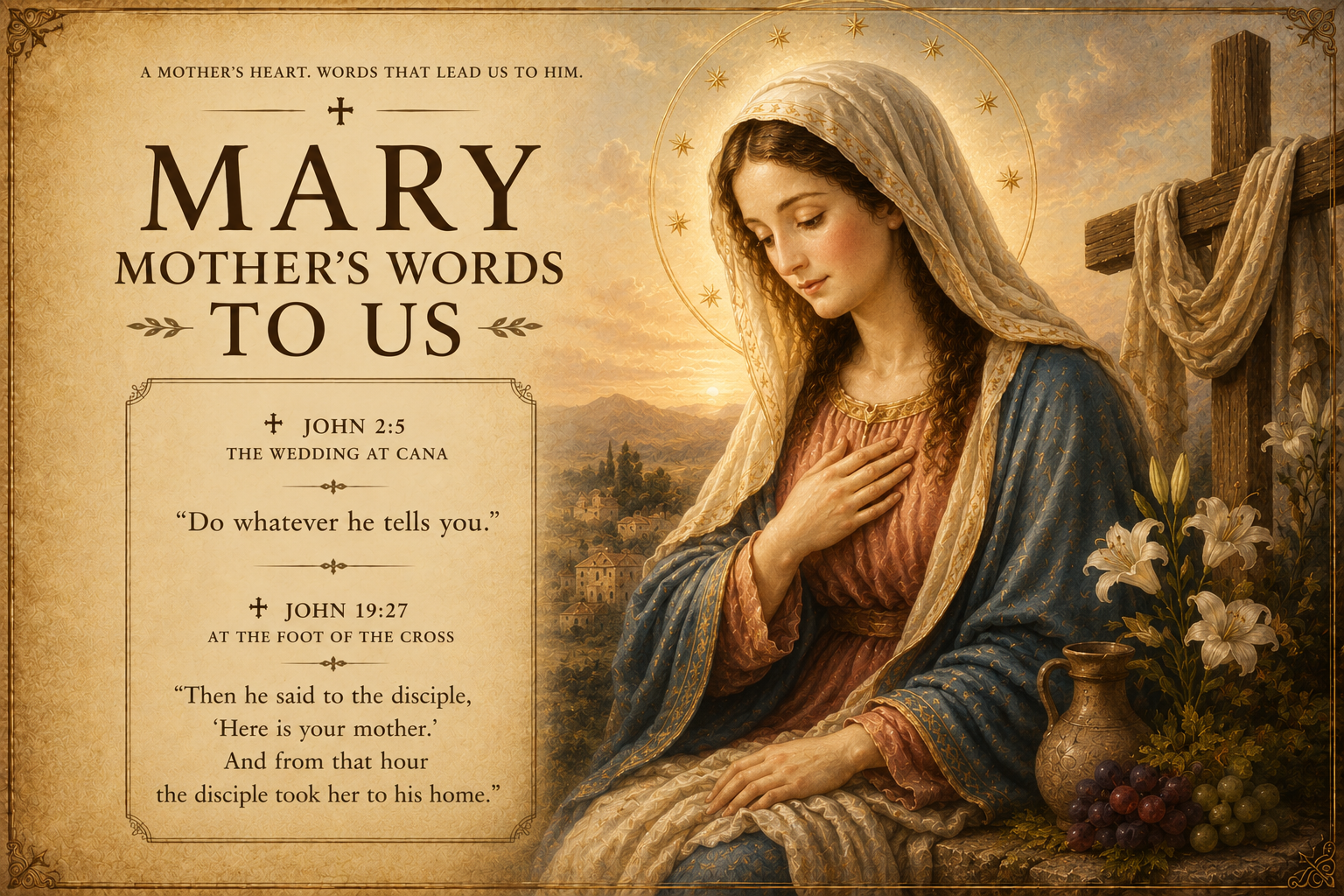
Our Lady of the Rosary: The Mother Who Gave Us the Beads
Mother’s Words to Us · Saturday 10 October 2026
Of all the Marian devotions the Catholic Church has carried, there is one that is older than most, more widespread than all, and more beloved by every Catholic in every corner of the world. The Rosary, the chain of beads on which the Catholic prays, in rhythm, one hundred and fifty Hail Marys divided into fifteen (later twenty) decades, each decade dedicated to one mystery of the life of the Lord Jesus Christ, was, by the ancient Catholic tradition, given personally by the Blessed Virgin Mary herself to Saint Dominic in a small Catholic church in Prouille, in southern France, in the year 1214. Six hundred and fifty years later, through Lourdes and Fatima, she returned with the beads in her hands, asking Catholics everywhere, to pray the Rosary daily. The Catholic feast of Our Lady of the Rosary is kept on 7 October, in gratitude for the Marian victory at Lepanto in 1571.
The hour
In the Catholic tradition carried by the Dominican Order from the beginning of its history, the Rosary was given personally by the Blessed Virgin Mary to Saint Dominic (1170 to 1221) in a Marian apparition at the small chapel of Prouille in Languedoc, southern France, in the year 1214. Dominic, who had been preaching for seven years against the Albigensian heresy with very little success, received from the Blessed Virgin a chain of beads, with the instructions to teach Catholics to pray, slowly, one hundred and fifty Hail Marys, meditating on the mysteries of the life of her Son, as a Marian weapon against heresy.
From this Marian seed grew the universal Catholic devotion of the Rosary. By the fifteenth century it had its stable form of fifteen mysteries, divided into Joyful, Sorrowful, and Glorious. In 2002, Pope Saint John Paul II, in his apostolic letter Rosarium Virginis Mariae, added the five Luminous Mysteries, drawn from the public ministry of the Lord Jesus Christ, making the full modern Rosary a cycle of twenty mysteries.
On 7 October 1571, the Battle of Lepanto: a Catholic coalition fleet of two hundred ships, under Don John of Austria, defeated the Ottoman Turkish fleet of three hundred ships off the Greek coast. Pope Pius V, in Rome, had asked the whole Catholic world to pray the Rosary for the Catholic forces throughout the day of 7 October. The Catholic coalition, outnumbered three to two, won. The Pope, miraculously receiving the news of the victory in Rome on the same day, before any messenger could have arrived, instituted the Feast of Our Lady of Victory, later renamed Our Lady of the Rosary, in perpetual Catholic gratitude.
The words
Of the countless Catholic texts in praise of the Rosary, the one line the Catholic Church has carried closest to its heart is the Marian promise given by Our Lady of Fatima, on 13 July 1917, in the sixth decade of her six Portuguese apparitions:
“I want you to continue praying the Rosary every day. I will come back to ask also for the Communion of reparation on the first Saturdays. If my requests are heeded, Russia will be converted and there will be peace. If not, Russia will spread her errors throughout the world. Only I can help you. Pray the Rosary every day.”
Our Lady of Fatima, Portugal, 13 July 1917
What she meant
Our Lady meant that the Rosary is her particular Marian weapon for the Catholic Church of the modern age. In every great Marian apparition of the past two hundred years, from Lourdes (1858) to Fatima (1917) to Beauraing (1932) to Kibeho (1981), the Blessed Virgin Mary has appeared holding a Rosary in her hands and has asked, as her primary Marian request, that Catholics pray the Rosary daily. The Marian insistence is so unbroken, from apparition to apparition, that no Catholic can pretend to have missed it.
Our Lady meant that the Rosary is a Marian school of contemplation. The one hundred and fifty Hail Marys are not primarily asking for favours. They are a Marian rhythm, in which the Catholic sits beside Mary and contemplates, mystery by mystery, the whole life of her Son. The repetition is not boredom. It is the Catholic equivalent of a mother rocking a child, in which the slow Marian rhythm quiets the Catholic heart until the Lord Jesus Christ himself can speak within it.
And Our Lady meant that the Rosary is the particular Catholic weapon against modern evils that no other prayer reaches. The modern Catholic battles, abortion, pornography, addiction, suicide, the collapse of the family, the loss of faith among the young, are, Our Lady said at Fatima, specifically answerable by the Marian daily Rosary. The daily recitation is, as Pope Pius XII called it, “the Marian ladder by which the Catholic Church of the twentieth and twenty-first centuries will be rescued.”
The witness
Every great Catholic Pope of the twentieth century, from Leo XIII (who wrote eleven Marian encyclicals on the Rosary) to Pius XI, Pius XII, John XXIII, Paul VI, John Paul II, Benedict XVI, and Francis, has placed the daily Rosary at the Marian heart of his Catholic programme.
Every great Marian apparition of the modern Catholic Church has asked for the Rosary. Our Lady of Lourdes carried a Rosary in her hands. Our Lady of Fatima handed Rosaries to the three Portuguese children. Our Lady of Beauraing was seen holding a Rosary. Our Lady of Kibeho taught the chaplet of the Seven Sorrows alongside the Rosary.
Every great Catholic saint of the modern Catholic Church has prayed the daily Rosary. Saint Louis de Montfort, Saint Alphonsus Liguori, Saint John Vianney, Saint Thérèse of Lisieux, Saint Pio of Pietrelcina (who prayed thirty Rosaries a day), Saint Teresa of Calcutta, Saint John Paul II. The Marian Rosary has become, in the past four hundred years, the single most widespread Catholic devotion in the whole Catholic Church.
Voices that came after
Saint Louis de Montfort (1673 to 1716), in his Secret of the Rosary, said, “The Rosary is the chain by which the Catholic soul is bound to Our Lady, and through her, to Christ. The devil has no more effective enemy than the daily Catholic recitation of the fifteen (or now twenty) decades.”
Saint Pio of Pietrelcina (1887 to 1968) called the Rosary “the Marian weapon that no Catholic can afford to lay down. The Catholic who prays the Rosary every day is a Catholic Our Lady herself has chosen to defend.”
Saint John Paul II, in Rosarium Virginis Mariae (2002), said, “The Rosary is my favourite prayer. It is a marvellous prayer. Marvellous in its simplicity, marvellous in its depth. It is a Marian compendium of the whole Gospel.”
Pope Francis, in his homily on Our Lady of the Rosary of 7 October 2016, said, “Every Catholic family that prays the daily Rosary together is a Catholic family the Mother will carry through the trials of the century. The Rosary is the family’s Marian armour.”
Why it still matters today
You live in a century in which the daily Rosary, the single most important Marian request of every modern Marian apparition, is prayed by perhaps fifteen per cent of baptised Catholics in the West. The ancient Catholic habit of the family Rosary, said together, after supper, under the Marian image on the kitchen wall, has in many Catholic homes disappeared altogether. The small chain of beads that Our Lady put in Dominic’s hands in 1214 sits, in many Catholic drawers, forgotten.
Our Lady of the Rosary walks across eight hundred years this Saturday morning, out of the small chapel at Prouille, out of the grotto at Lourdes, out of the Cova da Iria at Fatima, with a Rosary of fifty beads in her hands, into your kitchen, and says, with the certainty of a Mother who has asked for this exact thing in every apparition of the modern age:
🌷 “Pray my Rosary. Every day. One decade if you cannot pray five. One Hail Mary if you cannot pray a decade. Even one bead a day, held in your hand, said with love, is the Catholic weapon of the century.” 🌷
Starting this coming week, commit to one small daily Rosary. One decade. Five Hail Marys, meditating on one mystery of the life of her Son. Even that small Marian beginning, Our Lady of the Rosary promises you, with the certainty of a Mother who gave the beads to Dominic in 1214 and to Lucia at Fatima in 1917, is the exact doorway through which she wishes to carry you, slowly, through the twenty mysteries of a Catholic life.
A line to carry into the week
“Pray the Rosary every day.” 🌹
Our Lady of Fatima, 13 July 1917
🌷 Our Lady of the Rosary, Mother who gave Saint Dominic the beads at Prouille, Our Lady of Victory at Lepanto, pray for us.
Feast day: 7 October (Our Lady of the Rosary, Roman Catholic Church)