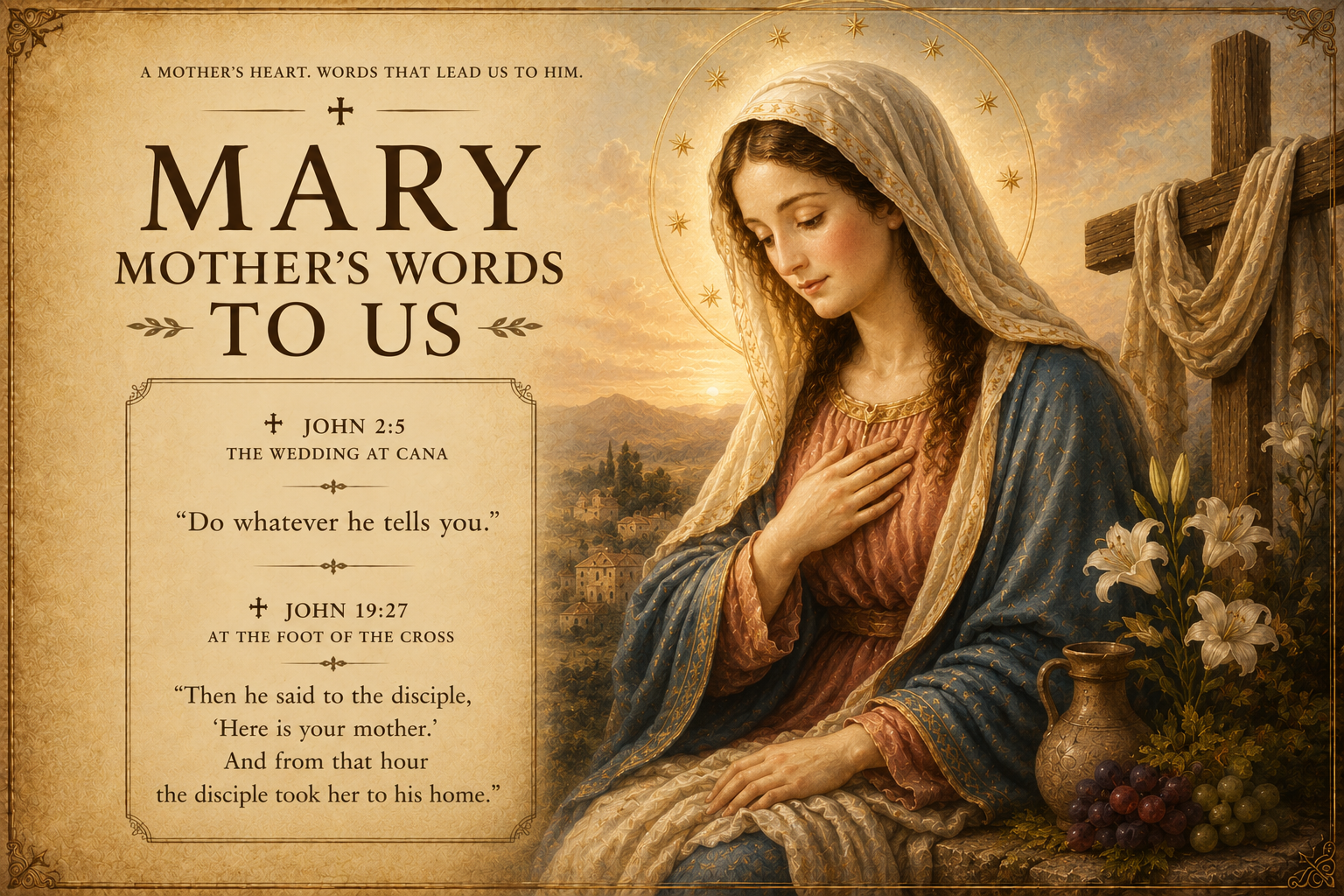
Our Lady of Perpetual Help: The Icon That Never Lets Go
Mother’s Words to Us · Saturday 25 July 2026
Of all the Marian images the Catholic Church has carried through the centuries, there is one Byzantine icon, written on wooden panels in Crete around the year 1300, that was brought to Rome in 1499 by a merchant, placed in a church that was later destroyed, lost for sixty-three years, found by Pope Pius IX in a Redemptorist convent in 1865, and placed by his order in the Redemptorist church of Saint Alphonsus Liguori on the Esquiline Hill in Rome, where it has hung ever since, over the main altar, with the Papal mandate, “Make her known throughout the world.” Her name is Our Lady of Perpetual Help, and in the past one hundred and sixty years, no Marian image has been more widely reproduced, more deeply loved, more constantly invoked, in the Catholic Church of the entire world.
The hour
The icon was written in the Byzantine Catholic tradition of Crete around 1300, by an unknown Greek iconographer. In 1499, after the Ottoman conquest, a Cretan merchant whose name is lost brought the icon to Rome and, dying, placed it in the care of a Roman family with instructions to enshrine it in a church. In 1500, after a miraculous healing, the icon was placed in the small Augustinian church of San Matteo in Merulana, on the Esquiline Hill, where it hung in a side chapel for the next three centuries, becoming beloved to the Roman faithful.
In 1798, the armies of Napoleon invaded Rome, suppressed many of the religious orders, and destroyed San Matteo. The elderly Augustinian friars rescued the icon and took it with them to a nearby priory. There it hung, forgotten, for the next sixty-three years. In 1863, an elderly Augustinian lay brother, Augustine Orsetti, who had been a server at the icon’s altar as a boy before 1798, happened to tell a young Redemptorist novice named Michael Marchi the story. Marchi, in his thirties, remembered the old brother’s words.
In 1865, Marchi, now Father Marchi, told Pope Pius IX, who had just granted the Redemptorists a church on the Esquiline, on the exact site of the demolished San Matteo. The Pope, hearing the story, said immediately: “The icon must come back to the Esquiline. Make her known throughout the world.” On 19 January 1866, the icon was carried in solemn procession through the streets of Rome and enshrined in the Redemptorist church of Saint Alphonsus. She has not moved since.
The words
Our Lady of Perpetual Help does not speak with ordinary words, as she did at Lourdes or Fatima. She speaks through the image itself, which the Catholic Church, following the ancient tradition of the Christian East, reads as a theological text. The Pope’s own mandate to the Redemptorists in 1866 is the Marian line the Catholic Church has carried ever since:
“Make her known throughout the world.”
Pope Pius IX to the Redemptorist Fathers, 11 December 1865
What she meant
The icon itself is a Marian sermon. The Blessed Virgin Mary, in the centre, holds her Son, the Lord Jesus Christ, in her left arm. On either side, two archangels, Saint Michael and Saint Gabriel, hover with the instruments of the Passion: Michael with the lance and the vinegar-sponge, Gabriel with the cross and the three nails. The child Jesus, looking at the instruments, has thrown himself in sudden fear into his Mother’s arms. His right sandal is falling off from the suddenness of his flight. His two small hands clutch his Mother’s right hand with a desperation the Catholic iconographer painted word by word.
And the Mother, in the centre of the composition, does not look at her Son. She looks straight out of the panel, into the eyes of whoever is standing before her. Her look is quiet, strong, infinitely tender, and infinitely sorrowful. The Catholic who stands before the icon is being told, in the oldest Marian iconographic language of the Christian East: Yes, your Lord has fled, in fear, into my arms. Yes, he knows what is coming. And yes, I am still looking at you, because you are also my child, and I will hold you too, when your own hour of fear comes.
And the Greek initials, in the ancient Byzantine abbreviations, read: Mother of God. Jesus Christ. The Archangel Michael. The Archangel Gabriel. The whole icon is, in effect, a visual catechism, teaching the whole mystery of the Incarnation, the Passion, and the Marian intercession, in a single wooden panel the size of a child’s book.
The witness
Since 1866, under the Papal mandate of Pius IX, the Redemptorist Fathers have carried the Marian devotion of Our Lady of Perpetual Help to every country in the world. Her reproduction hangs, today, in millions of Catholic homes, in every language, on every continent.
The Perpetual Help Novena, a public Marian devotion typically held on Wednesday evenings in Redemptorist parishes, became, in the twentieth century, one of the most widely attended Catholic devotions in the English-speaking world. In Manila alone, the Wednesday Novena at the Redemptorist shrine of Baclaran, Philippines, is attended, every single Wednesday, by more than one hundred thousand Catholics.
Pope Pius IX visited the shrine in Rome in person in 1866, kneeling before the icon with the Redemptorist community, and gave the icon the official title it still bears: Mater de Perpetuo Succursu, Mother of Perpetual Succour, Mother of Perpetual Help. Pope Leo XIII crowned her in 1867. Her feast is celebrated by the universal Catholic Church on 27 June.
Voices that came after
Saint Alphonsus Liguori (1696 to 1787), the founder of the Redemptorists and the great Marian Doctor of the eighteenth century, had already written his masterpiece The Glories of Mary a century before the icon was given to his sons. The whole book, in effect, is the theological commentary on the icon the Redemptorists would one day receive.
Saint John Henry Newman (1801 to 1890), writing in Birmingham in 1868, said of the icon, “The whole of what the Catholic Church teaches about Mary is written on that panel. It is the theological Rosary of the Christian East.”
Pope Francis, in his audience of 24 June 2016, for the one-hundred-and-fiftieth anniversary of the icon’s return to the Esquiline, said, “Our Lady of Perpetual Help carries the gaze of the Mother. She looks at us because she is afraid for us, because she loves us. Make her known. Make her image loved. In every Catholic home.”
Why it still matters today
You live in a century in which the Catholic home is often, visually, almost identical to the secular home. The walls are white. The art is abstract or seasonal. There is no small Marian image anywhere to catch the eye of the Catholic who moves through the house. The child who grows up in such a home has never, perhaps, looked into the eyes of the Mother of Perpetual Help in his own kitchen.
Our Lady of Perpetual Help walks across one hundred and sixty years this Saturday morning, out of the Redemptorist church on the Esquiline, out of the icon that has not moved since 1866, into your front hallway, and says, with the quiet certainty of a Mother whose face has looked back at Catholics for seven hundred years:
🌷 “Hang my image somewhere in your home. Look at me, from time to time. I will keep looking at you. Perpetual help means: the help that never ends.” 🌷
If you do not already have an image of Our Lady of Perpetual Help in your home, order one this week. Place it in the hallway, or over the kitchen table, or beside your bed. Look into her eyes once a day. Our Lady of Perpetual Help promises you, with the certainty of an icon that has survived the Ottoman conquest of Crete, the sack of Rome by Napoleon, and three centuries of hiding, that she will not stop looking at you until the hour of her Son.
A line to carry into the week
“Make her known throughout the world.” 🌹
Pope Pius IX to the Redemptorists, 1865
🌷 Our Lady of Perpetual Help, Mother of the icon that never looks away, pray for us.
Feast day: 27 June (Roman Catholic Church)