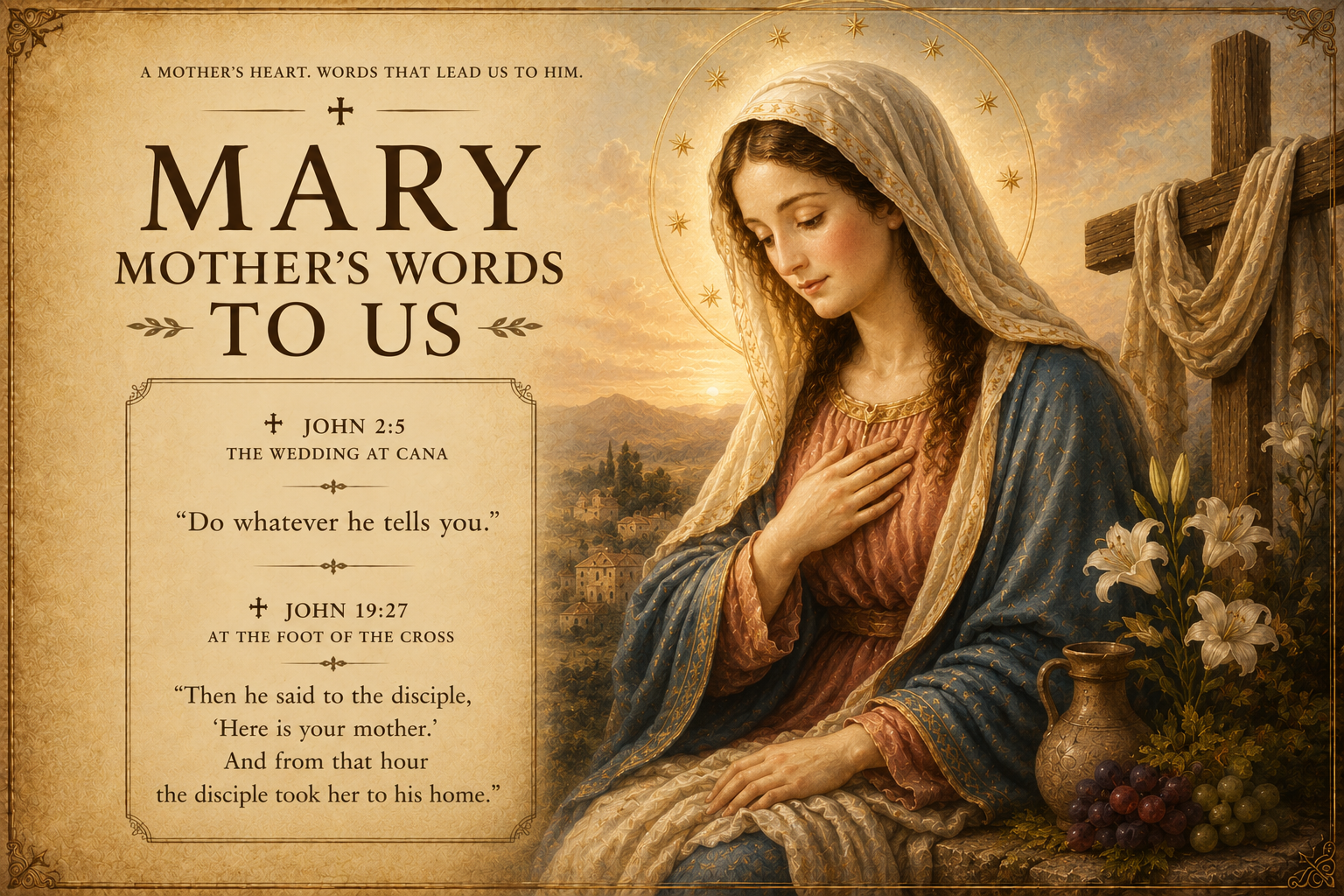
Our Lady of Walsingham: England’s Nazareth
Mother’s Words to Us · Saturday 26 September 2026
Of all the Marian apparitions the Catholic Church of England has carried through her long and difficult history, there is one, from a small Norfolk village in the eleventh century, when the Blessed Virgin Mary appeared in a dream, on three separate nights, to a devout Catholic Saxon noblewoman named Richeldis de Faverches, asking her to build in England a replica of the Holy House of Nazareth, the house in which the Angel Gabriel had come to the Virgin at the Annunciation. Richeldis built it in 1061. For four hundred and seventy-seven years, until the destruction by Henry VIII in 1538, Walsingham was the greatest Marian shrine of northern Europe, and England was called, in all the Catholic Christendom of the Middle Ages, Mary’s Dowry.
The hour
In 1061, in the small Norfolk village of Walsingham, a devout Catholic Saxon widow named Richeldis de Faverches, lady of the manor, prayed daily to the Blessed Virgin Mary to be shown some way to honour her in a particular Catholic place. On three separate nights, in a dream, the Blessed Virgin Mary took Richeldis in spirit to Nazareth and showed her the Holy House, the small Palestinian stone cottage in which the Angel Gabriel had come to her at the Annunciation.
The Blessed Virgin instructed Richeldis to measure the exact dimensions of the Holy House, to return to Walsingham, and to build an identical replica there, which she promised would become a place of Marian pilgrimage and a Marian centre for her English Catholic children. Richeldis obeyed. She returned to Walsingham, chose a plot of land near a well-spring where two miraculous rivulets of water appeared overnight, and had her builders begin construction. The Catholic tradition records that the builders failed, that night, to raise the house correctly, and that the Blessed Virgin herself, with the help of angels, moved the house to its proper site, and raised it correctly, overnight.
From the moment of its completion in 1061, Walsingham became the most beloved Marian shrine in Catholic England. From 1150 the house was enclosed in a larger priory church, and the Augustinian canons were given care of the shrine. For the next four hundred years, every Catholic King of England, from Henry I to Henry VII, made the Walsingham pilgrimage. The Catholic poor of England walked the Walsingham Way, often barefoot for the last mile called the Mile of Our Lady, in such numbers that the roads from London to Norfolk became permanent pilgrim routes.
In 1538, during the Protestant Reformation under Henry VIII, the shrine was violently suppressed. The Holy House was dismantled stone by stone, the Marian statue of Our Lady of Walsingham was burnt in London at Chelsea Cross, and the lead was stripped from the priory roofs. Walsingham, which had been for five centuries the Marian centre of English Catholicism, was reduced to ruins. The sacrilege, as Pope Pius XI called it four hundred years later, was total.
The Catholic restoration began in 1897, when Pope Leo XIII, on 6 February, formally re-established the shrine. A new Catholic church of Our Lady of Walsingham was built in nearby King’s Lynn. In 1934, a Catholic image was carried in solemn procession and enshrined at the restored Slipper Chapel, the only medieval chapel of the pilgrimage route that had survived Henry’s destruction. On 23 November 2015, the Catholic bishops of England and Wales re-dedicated England to Our Lady, renewing her ancient title as England’s Dowry. In 2020 the shrine of Walsingham was declared a Minor Basilica by Pope Francis.
The words
Of the Marian texts of the Walsingham tradition, the one the Catholic Church of England has carried closest to its heart is the ancient Catholic phrase in which the Blessed Virgin was understood to have claimed the Catholic nation of England as her own:
“Dos Mariae. England is Mary’s Dowry. The Catholic nation given to the Mother by her Son.”
Catholic title of England, recorded from the fourteenth century, revived by the Catholic bishops of England in 2015
What she meant
Our Lady meant that the Catholic Church of England is her personal Marian inheritance. In the medieval Catholic understanding, when a king gave his bride a dowry, that land, forest, or castle was hers in perpetuity, under her personal protection. The Lord Jesus Christ, in the Catholic imagination of the fourteenth century, had given to his Mother the whole Catholic nation of England as a dowry, under her perpetual Marian care.
Our Lady meant that she wished to live, in a Marian sense, in a small Norfolk village, in a replica of the house where she had herself lived two thousand years ago. The Catholic genius of Walsingham, which is quite unlike any other European Marian shrine, is that it is not an apparition site or a miracle well. It is a house, deliberately imitating the house of the Annunciation at Nazareth. The Catholic pilgrim who walks into the Holy House at Walsingham walks, as it were, into the Marian hearth of the Lord’s own earthly childhood.
And Our Lady meant something tender. She chose, as her Catholic English home, not the great cathedral city of Canterbury, nor royal Westminster, nor old Winchester. She chose a small Norfolk village of perhaps three hundred people, in the hands of a devout Catholic widow who had no particular influence. The whole Marian pattern of Walsingham, from 1061 to 1538 to 1897 to today, has been one of Catholic hiddenness, Catholic humility, Catholic rural quiet.
The witness
Every Catholic King of England from Henry I (1100) to Henry VII (1509) made the Walsingham pilgrimage, usually in the first year of his reign. Henry VIII himself, before his break with Rome, made the pilgrimage five times, the last time in 1521, walking the final mile barefoot. Seventeen years later, in a bitter Catholic irony, the same Henry destroyed the shrine.
Erasmus of Rotterdam, who visited Walsingham in 1511, left in his Pilgrimage for Religion’s Sake the most detailed Catholic eyewitness account of the shrine before the destruction. He describes the small Holy House, the ancient Marian statue of Our Lady of Walsingham on her oak throne, the two miraculous wells, the queue of Catholic pilgrims, the hundreds of silver and gold Marian ex-votos covering the walls.
The Catholic restoration since 1897 has brought Walsingham back to Catholic life. More than three hundred thousand Catholic pilgrims visit the shrine every year. The National Catholic Shrine of Our Lady of Walsingham, at the Slipper Chapel, is the official English Catholic pilgrimage centre. Every English Catholic diocese, every religious order, every Catholic parish in England and Wales, has formally dedicated itself to Our Lady of Walsingham since 2015.
Voices that came after
Saint John Henry Newman (1801 to 1890), in his 1849 sermon The Second Spring, foresaw the Catholic restoration of Walsingham: “The Mother of England has not forgotten her. Her ancient dowry will be given back. The Catholic Church of England will rise, as she has risen, from the ruins of her own ancient shrines.”
Pope Pius XI, in his address to the English Catholic bishops of 1933, called Henry VIII’s destruction of Walsingham “one of the great Marian sacrileges of the whole Protestant Reformation. The Catholic restoration of the shrine is the Marian rebuke of history to that sacrilege.”
Saint John Paul II, visiting England in May 1982, said, “I come as a pilgrim to the ancient Catholic nation of Mary’s Dowry. The whole of the English Catholic Church is her personal Marian possession. She has never left you.”
The Catholic bishops of England and Wales, on 29 March 2020, during the first COVID-19 lockdown, re-dedicated England to Our Lady of Walsingham through a live-streamed Marian consecration from the Slipper Chapel. The ancient Catholic title Dowry of Mary was publicly renewed by every Catholic bishop in England.
Why it still matters today
You live in a century in which many Catholic nations, including the ancient Marian ones, are undergoing a quiet re-paganisation. Catholic England, where Mass attendance has fallen to about four per cent of the baptised, is one of the clearest examples. The Marian conviction, held for a thousand years, that the Blessed Virgin personally cared for the Catholic nation, has, in many English Catholic parishes, almost disappeared.
Our Lady of Walsingham walks across nine hundred and sixty-five years this Saturday morning, out of the small Holy House in the Norfolk village, past the ancient oak throne, into every Catholic kitchen in the English-speaking world, and says, with the Marian certainty of a Mother whose Dowry nation nearly forgot her but was never forgotten by her:
🌷 “England is still mine. The Catholic Church of my Dowry nation is still mine. The small Catholic flame still burning in your parish is still mine. I have not left. I will not leave.” 🌷
Pray this coming week the ancient Catholic consecration prayer of Our Lady of Walsingham: “O Alone of all women, Mother and Virgin, Mother most happy, Virgin most pure, now, poor sinner, we beseech you, that your Son may hearken to our prayers. Pray for us, Our Lady of Walsingham.” Our Lady, in the Holy House, promises you, with the certainty of a Mother who has watched over her English Catholic Dowry for a thousand years, that she hears every single English and English-speaking Catholic voice that calls upon her.
A line to carry into the week
“England is Mary’s Dowry.” 🌹
Ancient Catholic title of England, 14th century, renewed 2020
🌷 Our Lady of Walsingham, Mother of the Holy House, Lady of England’s Dowry, pray for us.
Feast day: 24 September (Our Lady of Walsingham, National Shrine of England)