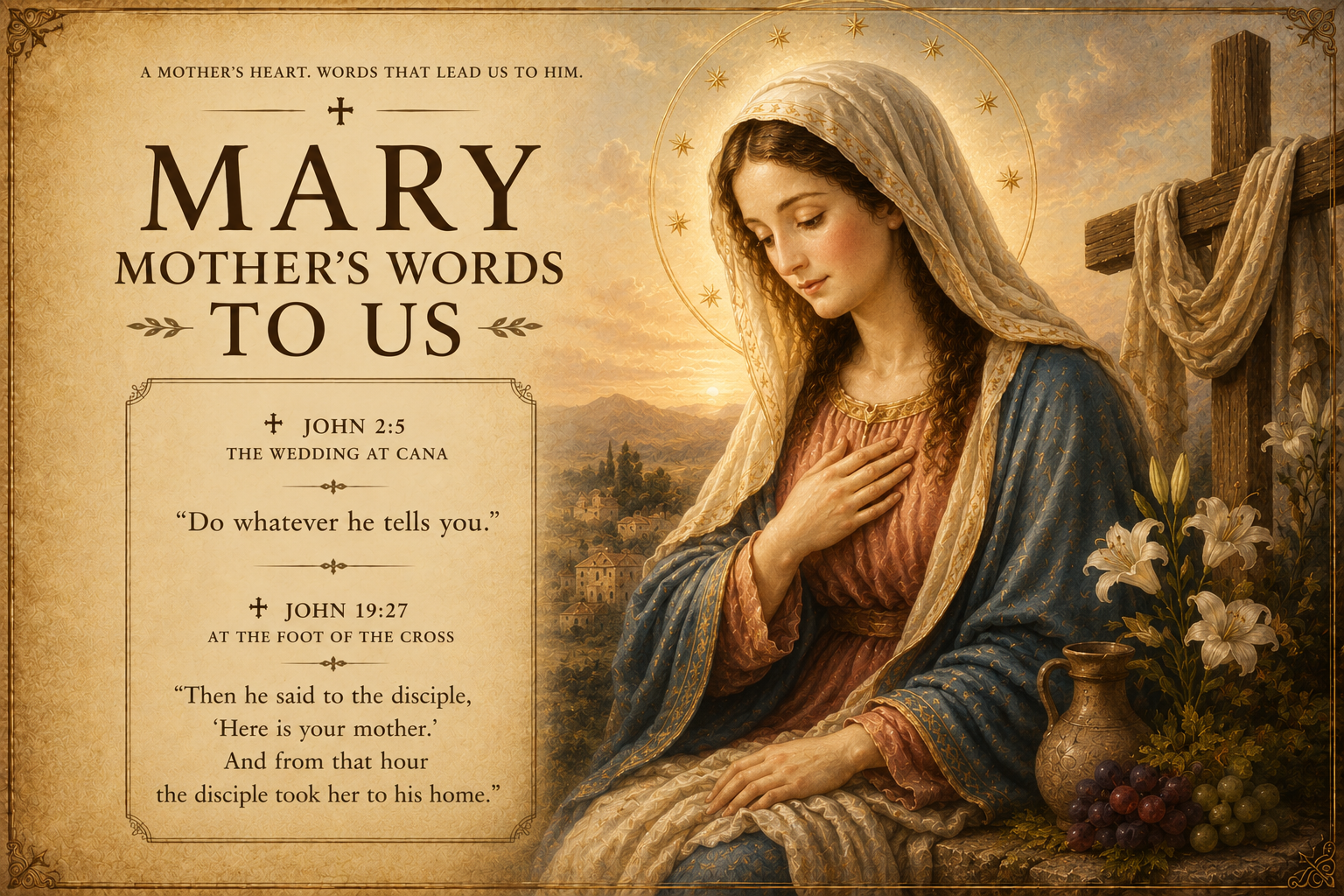
The Queenship of Mary: The Mother Crowned Beside Her Son
Mother’s Words to Us · Saturday 22 August 2026
Of all the Marian feasts the Catholic Church celebrates, there is one, kept exactly one week after the Assumption, which is the gentle Marian completion of what the Assumption began. On 15 August the Mother is taken up, body and soul, into the glory of her Son. On 22 August the Mother is crowned, by that same Son, as the Queen of heaven and earth. The two feasts together form a single Marian octave, in which the Catholic Church contemplates, with the full visual joy of her tradition, the Mother received into glory and then given the crown her Son has prepared for her from the beginning. Pope Pius XII established the Memorial of the Queenship of Mary in 1954. Pope Paul VI moved it to its current place on 22 August in 1969.
The hour
The Catholic conviction that Mary is Queen is as old as the Catholic Church. The Fathers of the first centuries called her, routinely, Regina caelorum, “Queen of the heavens.” The ancient Catholic antiphon Salve Regina, “Hail, Holy Queen,” which is still sung at the end of Compline in every Catholic monastery in the world, dates from the eleventh century, probably composed by Hermann of Reichenau around 1050. The ancient Catholic antiphon Regina Caeli, “Queen of Heaven, rejoice,” which is said at the Angelus throughout Easter, dates from the twelfth century.
The Catholic iconographic tradition of the Coronation of the Virgin, which has produced some of the greatest Western Catholic paintings (Fra Angelico, Botticelli, Raphael, Velázquez), has carried the same conviction in paint since the thirteenth century. The Fifth Glorious Mystery of the Rosary, meditated by Catholics since the sixteenth century, is explicitly the Coronation of the Blessed Virgin as Queen of Heaven and Earth.
On 11 October 1954, in his encyclical Ad Caeli Reginam, Pope Pius XII gave the Catholic conviction its liturgical form, instituting the Memorial of the Queenship of the Blessed Virgin Mary. The feast was originally kept on 31 May. In 1969, Pope Paul VI, in his reform of the Roman calendar, moved the feast to 22 August, exactly one week after the Assumption, to form the Marian octave of 15 to 22 August that the Catholic Church now celebrates each year.
The words
Of the countless Catholic texts on Mary’s Queenship, the one line the Catholic Church has carried closest to its heart is the opening of Pius XII’s encyclical, which gave the Marian title its official definition:
“From the earliest ages of the Catholic Church, a Christian people has believed that she whom the Angel Gabriel saluted as Full of Grace, chosen to be the Mother of God, is also, by that choice, Queen of heaven and earth. The Catholic Church venerates the Mother of her Lord as Queen, because the Son whom she bore is the eternal King of the universe.”
Pope Pius XII, Ad Caeli Reginam, 11 October 1954
What it means
The Catholic Church means that the Blessed Virgin Mary is Queen because her Son is King. The two titles are inseparable. Mary is not an alternative sovereign. She does not rival Christ. She reigns, as the Fathers said, with him and under him, in the exact way an earthly queen mother reigns with and under her royal son. The ancient Hebrew institution of the Gebirah, the queen mother of the Davidic kings, who sat at the right hand of the king and received the petitions of the people, is the biblical pattern of the Marian Queenship.
The Catholic Church means that the Catholic who prays to Mary as Queen is placing himself in a royal court. The Mother is seated beside her Son. The Catholic approaches the Lord Jesus Christ through her, not because the Son is distant, but because the Mother, as queen mother, has, by immemorial Davidic custom, the right to carry her child’s petitions to her royal Son with a certainty no ordinary subject can claim.
And the Catholic Church means that Mary’s Queenship is tender. She wears a crown, not of power that intimidates, but of maternal honour. The Fifth Glorious Mystery is contemplated with joy, not awe. The Mother who was poor in Nazareth, humble at Cana, silent at the foot of the Cross, is given, at the end, the exact crown her Son had always intended for her. The Catholic who prays the Salve Regina is addressing a crowned Mother who has not forgotten her poverty.
The witness
Every crowned Marian statue in a Catholic parish, from the small plaster Our Lady of Lourdes in a side chapel in Belgrade to the great gold-crowned Virgin of Czestochowa in Jasna Góra, is a visible echo of the Catholic feast of Marian Queenship.
Every Catholic Rosary ends, in its daily recitation, with the Salve Regina, the great medieval Marian antiphon addressed to “our Queen, our life, our sweetness, and our hope.”
Every Papal coronation of a Marian image, performed by the authority of the Chapter of Saint Peter in Rome, is a Marian institutional expression of the Catholic belief in her Queenship. The crowned images of Our Lady of Guadalupe (1895), Our Lady of Czestochowa (1717), Our Lady of Lourdes (1876), Our Lady of Fatima (1946), and hundreds of others, all crowned by Papal mandate.
Voices that came after
Saint Louis de Montfort (1673 to 1716), in his True Devotion to Mary, said, “Mary is Queen. The Catholic who places himself completely in her hands is placing himself in a Marian court. From there, no demon of hell dares to pass.”
Saint Maximilian Kolbe (1894 to 1941), who founded the Militia of the Immaculate and died at Auschwitz, taught his Franciscan community to call Our Lady “the Immaculate Queen of the whole Catholic militia.”
Saint John Paul II, who prayed the Salve Regina at the end of every single public Mass of his pontificate for twenty-seven years, said, “Mary is Queen because she is Mother. The Catholic devotion to her Queenship is the Catholic conviction that the throne of her Son is not a cold throne but a maternal one.”
Why it still matters today
You live in a century that is uneasy with the Catholic language of royalty. Monarchies have fallen almost everywhere. The Catholic devotion to a crowned Virgin and a reigning Christ feels, to many younger Catholics, old-fashioned, almost political. The Salve Regina, with its medieval Latin and its imagery of exile and tears and sweetness, is quietly disappearing from Catholic parish recitation.
Our Lady, Queen of Heaven and Earth, walks across two thousand years this Saturday morning, with the crown her Son placed on her head at her Assumption, into your kitchen, and says, with the quiet, maternal sovereignty of a Queen who was once a Nazareth village girl:
🌷 “My child, I am Queen because my Son is King. Come into our court. The throne is not far. The crown is maternal. I will carry your petition to him.” 🌷
Pray the Salve Regina today, slowly, in English or in Latin, perhaps at bedtime. Hail, Holy Queen, Mother of mercy, our life, our sweetness, and our hope. To you we cry, poor banished children of Eve. Our Lady, Queen of Heaven, promises you, with the certainty of a Mother crowned beside her Son, that she hears each line, that she carries each petition, that her court is open day and night.
A line to carry into the week
“Hail, Holy Queen, Mother of mercy, our life, our sweetness, and our hope.” 🌹
Salve Regina, Catholic antiphon, 11th century
🌷 Mary, Queen of Heaven and Earth, crowned beside your Son, pray for us.
Feast day: 22 August (Memorial of the Queenship of the Blessed Virgin Mary, Roman Catholic Church)