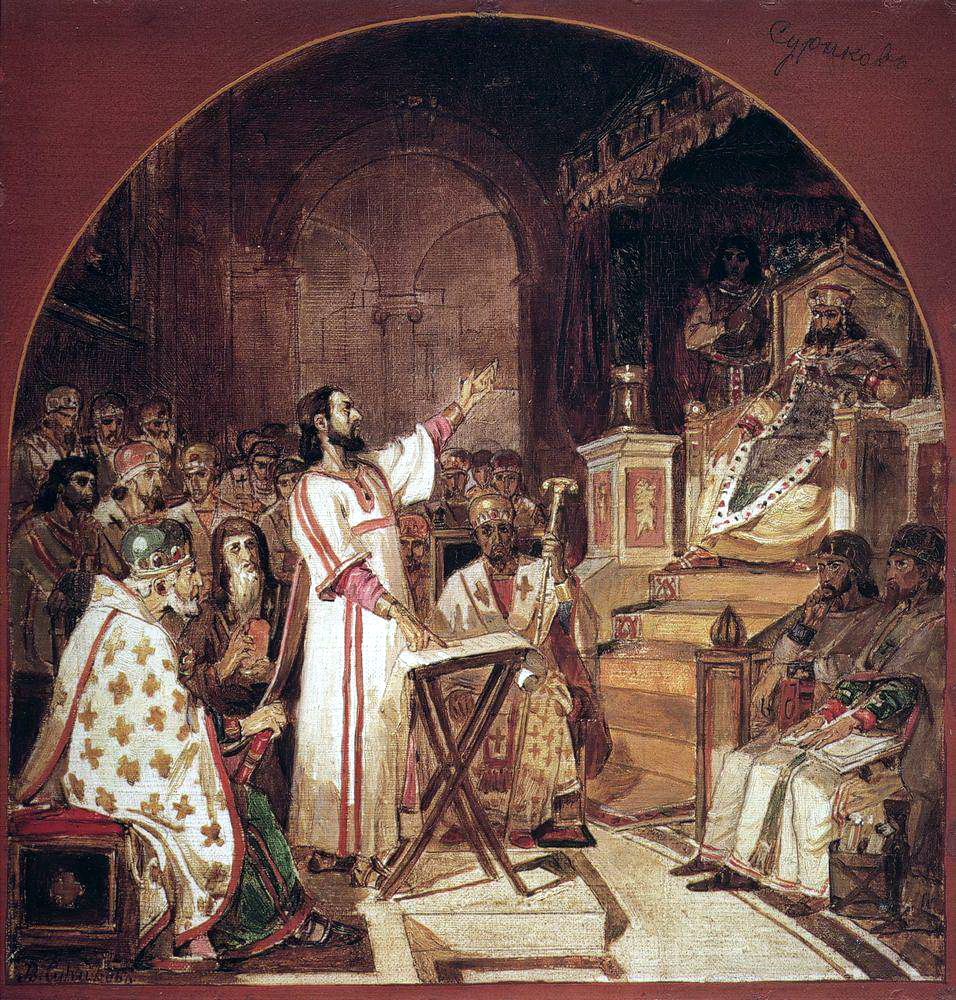
Before we ever pray a Hail Mary, we begin the Rosary by saying what we believe. The Creed comes first because it is the foundation; the mysteries that follow are the colors that fill in the picture this Creed has drawn. Without the Creed, the Rosary would be a beautiful sentiment. With it, the Rosary is the Gospel itself, prayed slowly through the heart of His Mother.
The Creed is the summary of the faith, and the faith is the response of man to the Word of God who has revealed Himself.
, Catechism of the Catholic Church §26
Two Creeds, One Faith
The Catholic Church prays two creeds, the Apostles’ Creed and the Nicene Creed. They are not rivals. They are two windows opening on the same house. The Apostles’ Creed is the older and simpler form, used at baptism, in the daily prayer of the Church, and at the beginning of the Rosary. The Nicene Creed is longer and more theologically precise, born in the great councils of the fourth century, and prayed every Sunday at Mass.
Both came out of the Church’s earliest centuries, when bishops needed to teach the faith clearly to the newly baptized and to defend it against errors that would have changed Christianity into something else. Both contain the same essential truths. To pray either is to stand with two thousand years of Christians on every continent who have professed the same faith in the same God.

The Apostles’ Creed
I believe in God, the Father almighty,
Creator of heaven and earth,
and in Jesus Christ, his only Son, our Lord,
who was conceived by the Holy Spirit,
born of the Virgin Mary,
suffered under Pontius Pilate,
was crucified, died and was buried;
he descended into hell;
on the third day he rose again from the dead;
he ascended into heaven,
and is seated at the right hand of God the Father almighty;
from there he will come to judge the living and the dead.
I believe in the Holy Spirit,
the holy catholic Church,
the communion of saints,
the forgiveness of sins,
the resurrection of the body,
and life everlasting. Amen.
How and when we got it
The Apostles’ Creed is the oldest creed of the Western Church. Its earliest known form is the Old Roman Creed, which the Church of Rome was using by the second century, around the year 150 A.D., as the profession of faith made by every adult candidate before baptism. The candidate stood in the baptistery, was asked, “Do you believe in God the Father almighty?”, and answered, “I believe.” Then, “Do you believe in Jesus Christ, His Son, our Lord?”, “I believe.” And so on through the three persons of the Trinity. To be plunged into the water was to be plunged into this faith.
From this baptismal questioning the Old Roman Creed grew. It received its present final form in the West sometime between the fourth and the eighth century, with the Latin text we now use stabilizing in northern France around the year 700. By the Middle Ages, every Catholic in the West was praying these same words.
The name “Apostles’ Creed” goes back to a beautiful tradition first attested by Saint Ambrose of Milan in the fourth century: that on the day of Pentecost, before the Twelve scattered to preach the Gospel to the ends of the earth, they composed this creed together, each apostle contributing one article so that, no matter where they went, they would be teaching the same Christ. Modern scholars take this as a pious tradition expressing a deeper truth: that the Apostles’ Creed contains, in its very simplest form, the faith the apostles received from Christ and handed on to us.

The Nicene Creed
I believe in one God, the Father almighty,
maker of heaven and earth, of all things visible and invisible.
I believe in one Lord Jesus Christ, the Only Begotten Son of God,
born of the Father before all ages.
God from God, Light from Light, true God from true God,
begotten, not made, consubstantial with the Father;
through him all things were made.
For us men and for our salvation he came down from heaven,
and by the Holy Spirit was incarnate of the Virgin Mary, and became man.
For our sake he was crucified under Pontius Pilate,
he suffered death and was buried,
and rose again on the third day in accordance with the Scriptures.
He ascended into heaven and is seated at the right hand of the Father.
He will come again in glory to judge the living and the dead
and his kingdom will have no end.
I believe in the Holy Spirit, the Lord, the giver of life,
who proceeds from the Father and the Son,
who with the Father and the Son is adored and glorified,
who has spoken through the prophets.
I believe in one, holy, catholic and apostolic Church.
I confess one Baptism for the forgiveness of sins
and I look forward to the resurrection of the dead
and the life of the world to come. Amen.
How and when we got it
The Nicene Creed was born in two great councils.
The First Council of Nicaea (325 A.D.) was called by the Emperor Constantine and presided over by approximately three hundred bishops from across the Christian world. The crisis they faced was the teaching of a priest named Arius, who held that Jesus Christ was a creature, the highest of all creatures, but still a creature, “less than the Father,” not truly God. If Arius were right, the Christian faith would collapse: the One we worship would not be God, and our salvation would not be salvation. The bishops at Nicaea responded with the most precise word in all of theology: Christ is homoousios, “of the same substance” as the Father, true God from true God. They composed a creed that said so explicitly. This is the heart of what we still pray.
The First Council of Constantinople (381 A.D.), fifty-six years later, expanded the Nicene Creed by adding the section on the Holy Spirit (“the Lord, the giver of life…”), answering a new error that had arisen in the meantime, denying the divinity of the Holy Spirit. With this addition, the Creed reached the form we now pray, and is properly called the Niceno-Constantinopolitan Creed, though most simply call it the Nicene Creed for short.
This is the Creed prayed at every Sunday Mass and every solemnity in the Roman Rite. It is the Creed prayed in Constantinople, in Rome, in Alexandria, in Antioch, in Moscow, in Manila, in Buenos Aires, by Catholics, Orthodox, and most Protestant churches. It is, in a sense, the most-prayed Christian text on earth after the Our Father.
The Differences Between Them
The two Creeds are saying the same thing, but with different voices. Here is how they differ:
Length and tone
The Apostles’ Creed is short, simple, and personal, the language of someone being baptized one Saturday night in a quiet candlelit baptistery. It begins “I believe” in the singular voice of one soul making its own confession. It is the Creed of a personal handing-over of the heart.
The Nicene Creed is longer, more elaborate, and more theologically precise, the language of a great council of bishops gathered to defend the faith of the Church against a worldwide error. It says “I believe in one God…” with strong emphasis on one, true, only-begotten, consubstantial. It is the Creed of an entire Church standing firm.
When each is used
The Apostles’ Creed is used at Baptism, in the Rosary, in the daily Liturgy of the Hours in some places, and in private devotion. It is sometimes prayed in place of the Nicene Creed at Sunday Mass during Lent and Easter, when the Church returns to its baptismal language.
The Nicene Creed is the Creed of the Sunday Mass and of every solemnity. It is the Creed prayed in most ecumenical councils and in the consecration of bishops. The Catholic Church and the Eastern Orthodox Churches share this Creed almost word for word, with one famous historical disagreement (see below).
A note on the Filioque
In the Catholic Latin tradition, the Nicene Creed says that the Holy Spirit “proceeds from the Father and the Son“. The Latin words and the Son are Filioque, added to the original creed in Spain in the sixth century and accepted in Rome by the eleventh. The Eastern Orthodox Churches, who share the Creed in every other respect, never accepted this addition; their version says only “who proceeds from the Father.” The dispute is one of the historical wounds between East and West, but the underlying truth, that the Holy Spirit comes from the love between the Father and the Son, is held by both traditions in different theological language.

The Biblical Foundation
Every line of the Creed comes from Scripture. The early Church did not invent the Creed; she gathered the words Christ had given her, the words the apostles had preached, and the words written down in the Gospels and Letters of the New Testament, and she wove them into a single short summary so that any believer could carry it in their heart.
Even within the New Testament itself, we can already see the Creed in seed-form. Saint Paul, writing to the Corinthians around the year 55 A.D., twenty years before the Gospels, quotes what is almost certainly an even older Christian creed:
For I delivered to you as of first importance what I also received: that Christ died for our sins in accordance with the Scriptures, that he was buried, that he was raised on the third day in accordance with the Scriptures, and that he appeared to Cephas, then to the twelve.
, 1 Corinthians 15:3-5
Other proto-creedal passages in the New Testament include the Trinitarian baptismal formula of Matthew 28:19 (“baptizing them in the name of the Father and of the Son and of the Holy Spirit”), the great Christ-hymn of Philippians 2:6-11, and the brief but striking confession in Romans 10:9 (“if you confess with your mouth that Jesus is Lord, and believe in your heart that God raised him from the dead, you will be saved”).
Article by article
Here is each main article of the Creed with the Scripture from which it comes:
- “I believe in God, the Father almighty, Creator of heaven and earth”, Genesis 1:1; Matthew 6:9; Acts 17:24
- “in Jesus Christ, his only Son, our Lord”, John 1:14; John 3:16; Acts 2:36
- “who was conceived by the Holy Spirit, born of the Virgin Mary”, Luke 1:26-38; Matthew 1:18-25
- “suffered under Pontius Pilate, was crucified, died and was buried”, Matthew 27; Mark 15; Luke 23; John 19
- “he descended into hell”, 1 Peter 3:18-20; 1 Peter 4:6; Ephesians 4:9-10
- “on the third day he rose again from the dead”, 1 Corinthians 15:3-4; Luke 24:1-7; Matthew 28
- “he ascended into heaven”, Acts 1:9-11; Luke 24:50-51
- “is seated at the right hand of the Father”, Acts 7:55-56; Hebrews 1:3; Psalm 110:1
- “from there he will come to judge the living and the dead”, Matthew 25:31-46; Acts 1:11; 2 Timothy 4:1
- “I believe in the Holy Spirit”, John 14:16-17, 26; John 16:7-15; Acts 2
- “the holy catholic Church”, Matthew 16:18; Ephesians 5:25-27; 1 Timothy 3:15
- “the communion of saints”, Hebrews 12:1; 1 Corinthians 12:12-27; Revelation 5:8
- “the forgiveness of sins”, Acts 2:38; 1 John 1:9; John 20:22-23
- “the resurrection of the body”, 1 Corinthians 15:42-44; Daniel 12:2; John 5:28-29
- “and life everlasting. Amen.”, John 3:16; John 17:3; Revelation 21:1-4
There is no article of the Creed that is not in the Bible. The Creed is, as the early Fathers said, “the Bible in summary”, the whole Scripture distilled into the shortest form a child can memorize and an old saint can die with.
Why We Begin the Rosary with the Creed
When we hold the crucifix at the start of the Rosary and pray the Apostles’ Creed, we are not just reciting a prayer. We are setting the foundation. We are saying: “Before I begin to walk through the life of Jesus with His Mother, let me first say what I believe about Him.”
Each of the twenty mysteries of the Rosary is contained, in seed, in the Creed. The Annunciation is “conceived by the Holy Spirit, born of the Virgin Mary.” The Crucifixion is “suffered under Pontius Pilate, was crucified, died and was buried.” The Resurrection is “on the third day he rose again from the dead.” The Assumption and Coronation are “the resurrection of the body, and life everlasting”, the destiny that Mary already shares and that the Church awaits.
So the Rosary begins with the Creed and ends with the Glory be, faith confessed at the start, the Trinity glorified at the end. In between, we walk slowly through the Gospel.