“In the name of the Father, and of the Son, and of the Holy Spirit.” — the Sign of the Cross
The most distinctive Christian belief about God — the one no other religion shares — is that the one God is three Persons. The Father, the Son, and the Holy Spirit are not three gods, nor three different ways of speaking about the same God; they are three eternal Persons in one divine nature, equal in glory, of one and the same substance. This is the doctrine of the Holy Trinity.
It is, the Church confesses, the central mystery of the Christian faith and of Christian life. Every prayer begins and ends with the Sign of the Cross. Every Mass invokes the Father, the Son, and the Holy Spirit. Every Christian Baptism is administered “in the name of the Father, and of the Son, and of the Holy Spirit.” The Trinity is not an abstract theological puzzle. It is the structure of every Christian moment.
What the doctrine says
The Catholic Church teaches that there is one God, eternal and uncreated, infinite in being and in love. This one God exists eternally as three distinct Persons:
- The Father — the source and origin from which the Son is begotten and from whom the Holy Spirit proceeds.
- The Son — the Word, eternally begotten of the Father, who in the fullness of time became man in Jesus Christ.
- The Holy Spirit — the Lord, the giver of life, who proceeds from the Father (and, in the Western tradition, from the Son), and who is sent to dwell in the hearts of those who believe.
Each is fully God; each is distinct from the others; yet there are not three Gods but one God. The Catechism of the Catholic Church puts it precisely: “The Trinity is One. We do not confess three Gods, but one God in three persons, the consubstantial Trinity” (CCC 253).
In Scripture
The full Trinitarian doctrine emerges from the New Testament. At the Baptism of Jesus in the river Jordan, all three Persons are revealed at once: the Son comes up from the water, the Holy Spirit descends as a dove, and the voice of the Father is heard from heaven, “This is my beloved Son, in whom I am well pleased” (Matthew 3:17). All three Persons are present, all three are distinct, all three are one in the work of salvation.
Jesus speaks to his Father in long prayers (most movingly in John 17). He promises to send another Advocate, the Spirit of truth (John 14:16). At the close of his earthly mission he commands his disciples: “Go therefore and make disciples of all nations, baptizing them in the name of the Father, and of the Son, and of the Holy Spirit” (Matthew 28:19). One name. Three Persons.
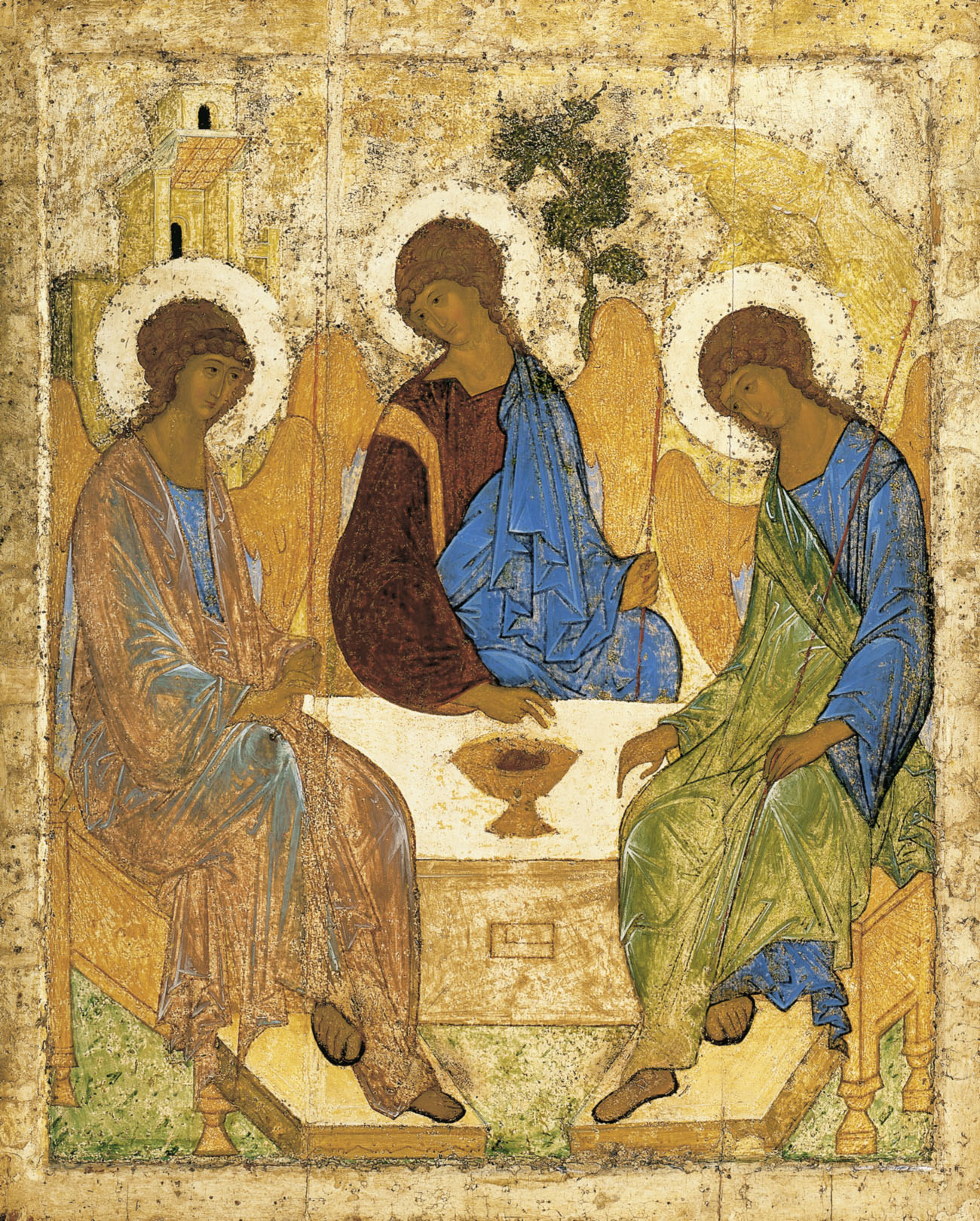
The Old Testament does not yet teach the Trinity directly — the great revelation of God’s oneness had to come first, against the polytheism of the surrounding nations. But there are hints throughout: the strange “us” of Genesis 1:26 (“Let us make man in our image”); the three angelic visitors who appear to Abraham at Mamre (Genesis 18) — the very scene Andrei Rublëv’s great icon depicts; the Spirit of God hovering over the waters at creation; the Word of God that creates and calls.
Holy, holy, holy is the Lord of hosts; the whole earth is full of his glory.
— Isaiah 6:3, the threefold Sanctus that the Christian liturgy has sung in every age
How the doctrine was defined
In the early centuries of the Church, the doctrine of the Trinity was clarified through a series of great Ecumenical Councils, often in response to teachings that misstated some part of it.
- Council of Nicaea (325) — against Arius, who taught that the Son was a creature, not God. The Council declared that the Son is homoousios (consubstantial) with the Father: God from God, Light from Light, true God from true God. The first version of what we now call the Nicene Creed was written here.
- Council of Constantinople (381) — expanded the Creed of Nicaea to clearly affirm the divinity of the Holy Spirit, against those who denied it (the “Pneumatomachi”). The Spirit was confessed as “Lord and giver of life, who with the Father and the Son is adored and glorified.” The result is the Nicene Creed we still pray today.
- Council of Ephesus (431) — affirmed that Jesus is one Person with two natures, and that Mary is the Mother of God (Theotokos). Against Nestorius.
- Council of Chalcedon (451) — clarified that the divine and human natures in the one Person of Christ are united “without confusion, without change, without division, without separation.” One Person, two natures.
The bishops who hammered out this language were doing it in love of the truth. They were trying to say what could be said about a mystery they knew was beyond saying. Saint Athanasius of Alexandria, defender of the Council of Nicaea, was exiled five times in defense of the Son’s divinity. Saint Basil the Great wrote his great treatise On the Holy Spirit defending the divinity of the Spirit. The doctrine was not invented by these men. It was guarded by them.
The icon at the head of this page
The icon is by the Russian monk Andrei Rublëv (c. 1370-1430), and is among the most famous religious paintings ever made. It depicts the three angelic visitors who came to Abraham at the oak of Mamre (Genesis 18) — understood by the Christian tradition as a foreshadowing of the Trinity. The three figures are arranged around a chalice on the altar (the Eucharist), bowing in mutual love and contemplation. They are clothed in different colors of garments, but their faces are nearly identical — one in being, three in person.
The Russian Orthodox Church declared this icon — just this single image — theologically definitive in 1551, at the Stoglav Council, ruling that all future Russian icons of the Trinity should be modeled on it. It hangs today in the Tretyakov Gallery in Moscow.
It is one of the great visual aids of Christian theology. Note the empty space at the front of the icon: there is room at the table for you. The Trinity is not a closed circle — it is the love into which we are invited.
The Western theology of the Trinity
In the Latin West, the great study of the Trinity is De Trinitate, the fifteen-volume work of Saint Augustine, written between 400 and 419. In it, Augustine defended the Trinity philosophically and offered analogies from the human soul: the mind, its self-knowledge, and its self-love form a kind of trinity in unity — three distinct things, one substance. “If you understood it,” he famously wrote, “it would not be God.”
Saint Thomas Aquinas in the thirteenth century built on Augustine’s analysis. The Father, in the Thomistic tradition, eternally begets the Son as the perfect Word of his self-understanding; the Holy Spirit eternally proceeds from the Father and the Son as the Love between them. This is the doctrine of “subsistent relations” — the three Persons are distinguished from one another only by their relations within the one God.
Saint Patrick is said to have used the three-leaf shamrock to teach the Irish. Saint Bonaventure used the Sun (light, heat, and ray, all one). None of these analogies is sufficient. None is meant to be. The Trinity is approached, not solved.
How to begin to contemplate the Trinity
No human mind can fully comprehend the Trinity. The Christian saints have always insisted on this. The deepest way to know the Trinity is not by analogy but by life: by being baptized into the Trinity, by praying the Sign of the Cross, by being drawn into the love between the Father and the Son in the Holy Spirit.
When the Spirit of his Son into our hearts, crying, “Abba! Father!”
— Galatians 4:6
Christian prayer is itself Trinitarian. To pray is to be inside the love of God. The Holy Spirit, indwelling in the soul of the baptized, prays in us to the Father through the Son. “We do not know how to pray as we ought, but the Spirit himself intercedes for us with sighs too deep for words” (Romans 8:26). The Trinity is not just a doctrine to be believed; it is the place we live whenever we pray.
Practical ways to begin contemplating the Trinity:
- Pray the Sign of the Cross slowly. Place each Person at each touch of the hand. Father, forehead. Son, heart. Holy Spirit, both shoulders. Take five seconds.
- Pray the Glory Be slowly. Glory to the Father. Stop. Glory to the Son. Stop. Glory to the Holy Spirit. Stop. Each Person separately, all three together.
- Sit before Rublëv’s icon. Just look. Notice the colors. Notice the empty seat at the table. Stay for ten minutes.
- Pray the Nicene Creed at Sunday Mass with attention. Each phrase is a word fought for, defended, prayed in.
A small reflection
The Trinity is not a riddle. It is the deepest truth there is. God is not a solitary, distant power; God is, in his very being, communion. The reason that love is the highest law is that love is what God is. “God is love,” Saint John writes (1 John 4:8) — and the love is not a quality God has, but the relationship at the heart of who God is. Father, Son, and Holy Spirit have loved one another, before the world began, and into all eternity.
To enter the Christian life is to be invited into that love. To be baptized is to be plunged into the Trinity. To pray is to be carried, in the Spirit, through the Son, into the heart of the Father. To love another human being well is to image, in our small way, the love that has always been God.
 Journey with Mary: A Path to Jesus