
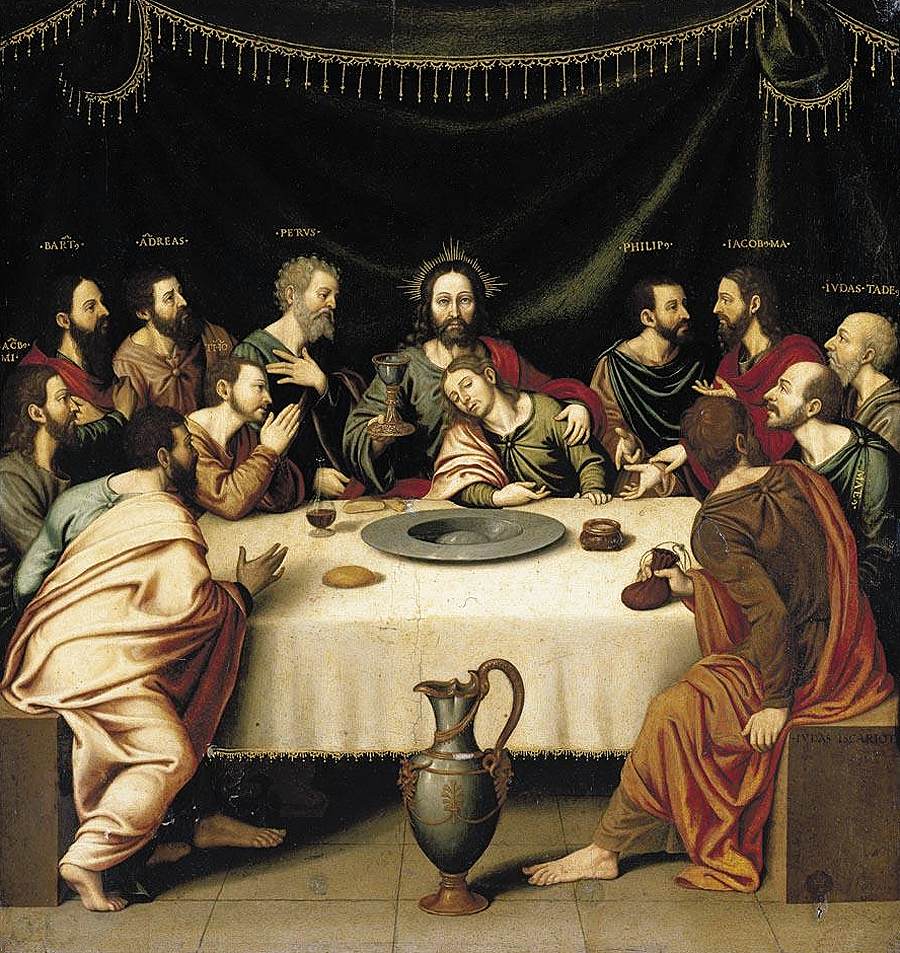
“This is my Body, which is given for you. Do this in remembrance of me. … This cup is the new covenant in my Blood, which is poured out for you.”
, Words of Institution, the night before he died
The Jewish Roots of the Eucharist
Christ did not invent the Eucharist out of nothing. Every word at the Last Supper, every gesture, every echo of the Passover meal, it all reaches back into 1500 years of Jewish covenant theology. The Catholic biblical scholar Brant Pitre has shown how four streams of Old Testament tradition converge in the upper room.

The Passover
Exodus 12
In Egypt, a lamb without blemish is slain; its blood marks the doorposts; its flesh is eaten. The angel of death passes over. Christ becomes the new Paschal Lamb whose flesh is eaten and whose blood saves the world.

The Manna
Exodus 16
In the wilderness, God feeds Israel with bread from heaven, falling each morning. “I am the bread of life… My Father gives you the true bread from heaven” (John 6:32, 35). The new manna.

The Bread of the Presence
Exodus 25:30, 1 Samuel 21
In the Temple, twelve loaves of the Lechem ha-Panim, literally “Bread of the Face of God”, sat continually on the golden table. Pilgrims were shown the bread and told: “Behold, the love of the Lord for you.”
The New Covenant
Jeremiah 31:31
Jeremiah prophesied a new covenant the Lord would make with His people, written on their hearts. At the Last Supper, Christ took the cup and said: “This is the new covenant in my Blood.” The promise fulfilled.
For a beautiful, full presentation of these Jewish roots, listen to Dr. Brant Pitre, author of Jesus and the Jewish Roots of the Eucharist (Doubleday, 2011):
“Jesus and the Jewish Roots of the Eucharist”, Dr. Brant Pitre, Catholic Productions
The Real Presence
When the Catholic Church says “the Eucharist,” she means something specific and astonishing: that the bread and wine consecrated at every Mass truly become the Body and Blood, soul and divinity, of Jesus Christ. Not a symbol. Not a memorial alone. A real presence.
This is what Christ said in John 6, and the disciples who could not accept it walked away. “This is a hard saying; who can listen to it?” (John 6:60). Jesus did not call them back, did not soften the words. He turned to the Twelve and asked: “Will you also go away?” Peter answered for the Church, then and ever since: “Lord, to whom shall we go? You have the words of eternal life” (John 6:67,68).
The Council of Trent (1551) gave the doctrine its precise theological name: transubstantiation. The substance of the bread becomes the substance of Christ’s Body; the substance of the wine becomes the substance of His Blood, though the appearance of bread and wine remains. It is the deepest mystery of the Catholic faith and the closest meeting between heaven and earth that this side of death allows.
Bishop Robert Barron on the Real Presence, Word on Fire
The Mass and Eucharistic Adoration

The Mass is the place where the sacrifice of Christ is made present again, not repeated, but re-presented. The same offering of Calvary, available now, here, on this altar, in this parish, in this small town anywhere on earth. The priest does not perform it; Christ Himself is the priest, and the priest is His instrument.
Eucharistic Adoration is the contemplation of the Eucharist outside Mass. The consecrated Host is exposed in a monstrance, a beautiful golden vessel with rays radiating outward from the centre, and the faithful sit, kneel, or pray quietly before it. It is one of the most powerful forms of Catholic prayer.
There are parishes that keep perpetual adoration, the Blessed Sacrament exposed twenty-four hours a day, with the faithful taking turns to keep watch. Christ is never alone in these chapels. Pope Saint John Paul II wrote that the Church draws her life from the Eucharist; without it, she would die.
Eucharistic Miracles
For two thousand years, in moments of doubt or as gifts of grace, the Lord has given the Church visible signs that the Eucharist is what He said it is. Bread that bleeds. Hosts preserved without decay for centuries. Tissue analyzed under modern microscopes that reveals living human heart muscle.
Lanciano, Italy (8th century). A monk doubting the Real Presence saw the Host turn into living flesh and the wine into blood. Modern scientific analyses (1971, 1981) confirmed: human cardiac tissue, type AB blood, no preservatives, still living.
Buenos Aires (1996). A consecrated Host fell to the floor and was placed in water to dissolve. It did not dissolve; it became flesh. Tested by an unbelieving cardiologist in California, type AB blood, living myocardial tissue, in inflammation. The Cardinal Archbishop who oversaw the investigation was named Jorge Bergoglio. He became Pope Francis.
Sokółka (2008) and Legnica (2013), Poland. Two more recent miracles, both formally examined and recognized by the Church.
These signs do not create the faith, they confirm it. They are mercies for an age that wants to see.

How to Receive Communion
Prepare your soul. Catholics in a state of grave sin should go to Confession before receiving. The Church teaches that one ordinarily fasts for one hour before Communion (water and medicine excepted).
Approach with reverence. Walk slowly. When the priest or extraordinary minister says “The Body of Christ,” respond firmly: “Amen.” That word means: I believe.
Receive on the tongue or in the hand. Both are permitted in the Roman Rite. If receiving in the hand, place your dominant hand under the other to make a small throne for the King. After receiving, consume the Host immediately, before returning to your seat.
Make a thanksgiving. The minutes after Communion are among the holiest of your life. Mary is closer to her Son than ever, and you are carrying Him within you. Speak to Him simply. Listen.
A Eucharistic Hymn, Tantum Ergo
The Tantum Ergo is the closing hymn of every Eucharistic Adoration in the Latin Church. It is the last two verses of the great Eucharistic hymn Pange Lingua, written by Saint Thomas Aquinas in 1264 for the new Feast of Corpus Christi.
Tantum Ergo Sacramentum, Catholic Latin Hymn for Adoration / Corpus Christi
Soul of Christ, sanctify me. Body of Christ, save me. Blood of Christ, inebriate me. Water from the side of Christ, wash me. Passion of Christ, strengthen me. O good Jesus, hear me. Within thy wounds, hide me. Amen.
, Anima Christi, prayer prayed by saints for centuries after Communion